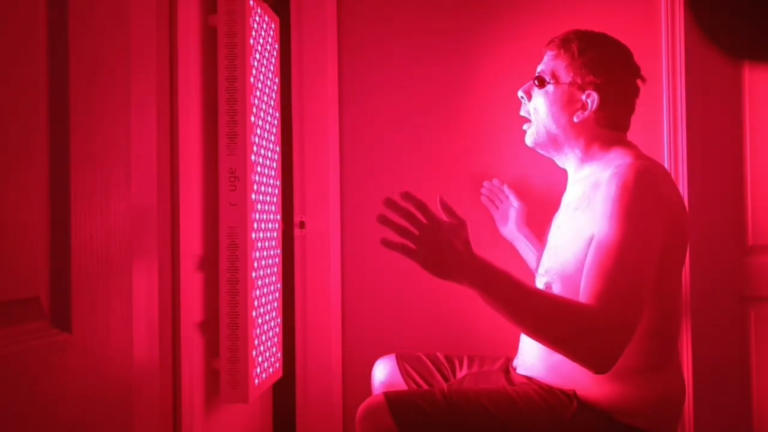





The last move nearly buried me — and it wasn’t the boxes. Cognitive overload, emotions that hijacked my symptoms in both directions, and a body that finally said no. This is what a move with Parkinson’s actually costs, and what I learned about the three separate waves you have to survive. And if you’re a caregiver feeling the weight of it all — the burnout is real, and we talk about it openly here.
Table of Contents
>- Watch the full film first
- The short version
- The three lenses
- 1. Cognitive — the avalanche I couldn’t dodge
- 2. Emotional — feelings that hijacked my symptoms
- 🌿 The tool that helped — Rouge
- 3. Physical — a body that finally said no
- Caregiver Corner — Hayley & Felicia
- Key Takeaways
- FAQ
- Where you are in this journey matters
- Keep going deeper
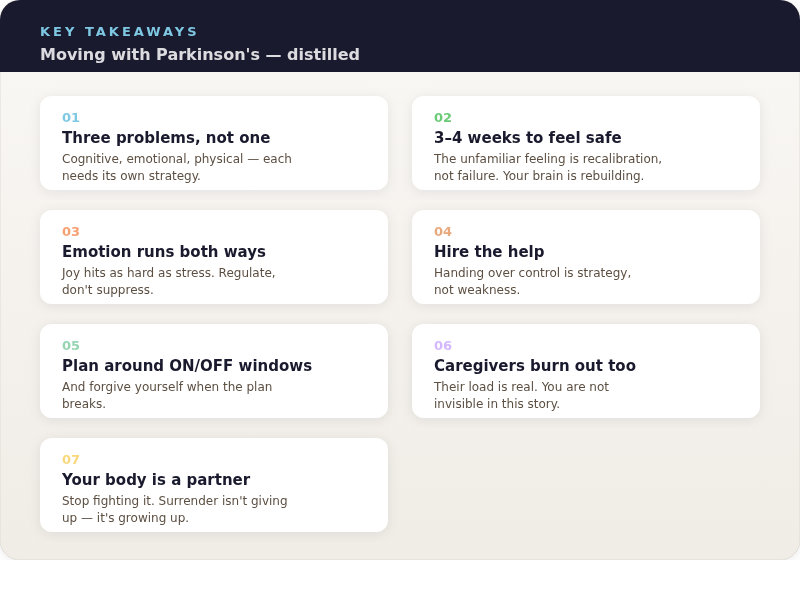
Key Takeaways
>Everything below, distilled. Read this first, then dive in. Share it with someone who needs it.
- A move is three problems, not one — cognitive, emotional, physical. Each wave hit differently and needed a different response. Don’t expect a single strategy to cover all three. Treat the fog, the feelings, and the fatigue as separate battles.
- Give yourself 3–4 weeks to feel safe in a new space — the “unsafe” feeling is recalibration, not failure. Your brain is rebuilding its mental map from scratch. That takes time, and that’s okay.
- Emotion runs symptoms both ways — happiness can hit as hard as stress. Joy, excitement, and relief are just as activating as fear and sadness. Regulate, don’t suppress. Your nervous system needs settling, not slogans.
- Hire the help. Surrender the lifting. Handing over control — letting other people do the heavy work, letting the timeline slip — feels like giving up at first. It isn’t. It’s the smartest thing you can do. Your body knows its limits; listen before it forces you to.
- Plan big things around ON/OFF windows — and forgive yourself when the plan breaks anyway. Medication timing dictates what’s possible, and it won’t always cooperate. Flexibility is a survival skill.
- Caregivers burn out too. Their load is real and deserves its own care. The person with Parkinson’s isn’t the only one who needs support. If you’re a caregiver, read the Caregiver Corner — you’re not invisible in this story.
- Your body is a partner, not an enemy. Stop fighting it and it’ll tell you what it needs. The move taught me that surrender isn’t giving up — it’s growing up. Listen to what your body is saying before it has to shout.
Watch the full film first
>If you haven’t seen it yet, this is the story in my own words — 33 minutes, told honestly. It’s the anchor for everything below.
Moving | Why I Can’t Hide From This Anymore — the three-lens breakdown begins at 1:37.
The short version
>A move isn’t just heavy boxes. It’s a full-body stress test on a nervous system that’s already working overtime. Over the past month I watched myself go through three distinct waves — cognitive, emotional, physical — and each one hit my Parkinson’s differently. Here’s what happened, what I learned, and what might help if you’re facing the same.
My honest truth: I’ve said before that I firmly believe every one of you is doing the best you can with the circumstances you’re in. This move was me living that out loud. It was hard. It was humbling. And I’m okay saying so.
🎬 Short on time? Here’s the 5-minute version of this same story: Moving, Milestones, and Reality — a 5-minute update. Perfect for when you can’t sit down with the full 33 minutes.
The three lenses
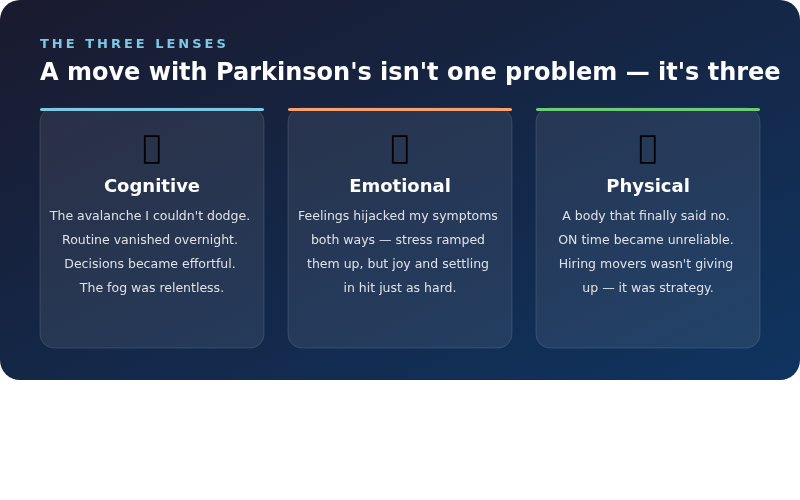
>A move with Parkinson’s isn’t one problem. It’s three problems stacked on top of each other, and they don’t move in sync.
- Cognitive — the avalanche I couldn’t dodge
- Emotional — feelings that hijacked my symptoms in both directions
- Physical — a body that finally said no
If you’re newly diagnosed 🌱, a caregiver 💛, or further along the road 🕰️ — this breakdown is for you. I’ll flag what each section means for your path.
1. Cognitive — the avalanche I couldn’t dodge
>A move is chaos. New surroundings, boxes everywhere, a thousand tiny decisions about where things go and what stays. For most people, that’s tiring. For someone with Parkinson’s, it’s cognitive overload on a scale I wasn’t prepared for.
The routine I’d built over years — the one that kept my brain feeling safe — was gone overnight. Every morning I had to re-learn where the coffee was, where the light switch was, how to move through a space that didn’t match the map my brain had built.
What that means for me: my thinking slowed. Decisions that used to be automatic became effortful. And the fog was relentless.
The timeline that surprised me: it took three to four weeks before this new space started to feel safe — before my brain stopped treating every corner as unfamiliar. That wasn’t weakness. That was a nervous system recalibrating.
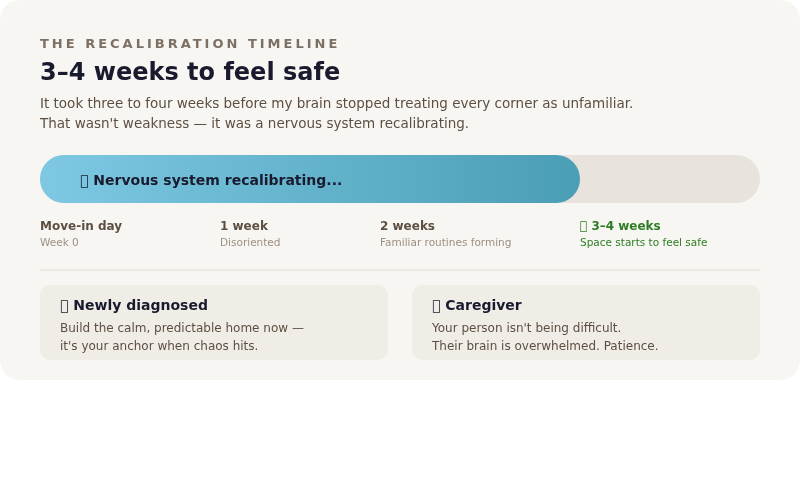
🌱 If you’re newly diagnosed: this is a preview of how much environment and routine matter. Build the calm, predictable home now — it becomes your anchor in moments like this.
💛 If you’re a caregiver: the person you’re supporting isn’t being difficult during a move. Their brain is genuinely overwhelmed. Patience isn’t a favour — it’s the treatment.
🕰️ If you’ve been at this for years: you know how much environment matters. What changes with a move is that the map your brain built — the one that let you navigate your day on autopilot — gets erased overnight. Years of hard-won routine disappear into boxes. The 3–4 week recalibration still applies, but the margin is thinner. Be extra gentle with yourself while your brain rebuilds.
2. Emotional — feelings that hijacked my symptoms
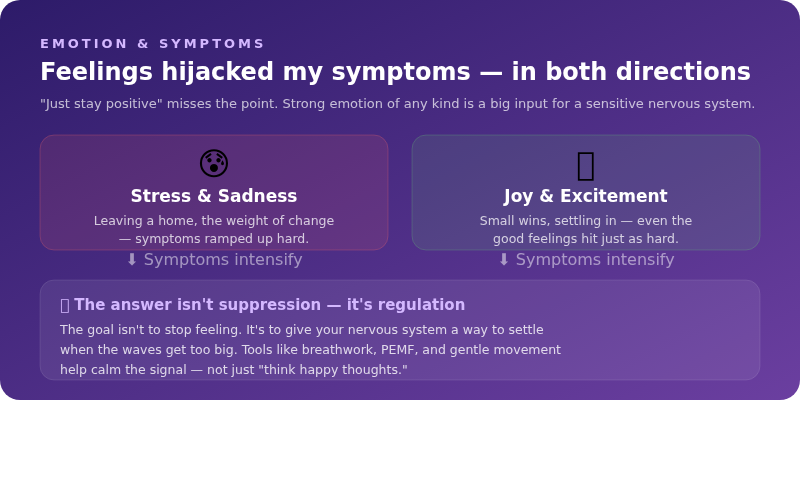
>Here’s the part I don’t talk about enough: my emotions ran my symptoms in both directions. The stress and sadness of leaving a home ramped my symptoms up. But here’s the twist — the happy moments did too. The joy of settling in, of small wins, hit me just as hard.
People love to say “just stay positive.” That advice misses the point. With a nervous system like mine, strong emotion of any kind is a big input. It’s like being a sensitive instrument — you don’t want to unplug it, but you have to learn how to tune it.
🔬 See the science behind this:
The Parkinson’s Breakthrough Nobody’s Talking About — why regulating the nervous-system signal matters more than “thinking happy thoughts.”
The refuge that helped: when the emotional load got too heavy, I reached for nervous-system regulation tools that actually calmed the signal — not just “thinking happy thoughts.” One of them (the Rouge device) gave my system a way to settle when the waves were too big. You can read more in the tools section below.
💛 If you’re a caregiver: please don’t tell your loved one to “just cheer up.” When they’re happy and when they’re sad can both be hard. What they need is calm regulation, not a pep talk.
🌱 If you’re newly diagnosed: this part surprises most people — your emotions will run your symptoms in both directions from day one. The happy moments will hit you as hard as the hard ones. That’s not a bug, it’s how a sensitive nervous system works. Knowing that now lets you plan for it: build regulation tools early, before the big emotional moments arrive.
🕰️ If you’ve been at this for years: you already know your emotions run your symptoms. But a move amplifies everything — loss, hope, exhaustion, relief — all stacked on top of each other. The regulation toolkit you’ve built over the years probably got packed in a box somewhere. Dig it out first. It matters more than the dishes or the clothes.
🌿 The tool that helped my nervous system settle — Rouge
>In the film, there’s a moment where I talk about the emotional wave getting too big to “think” my way out of. That’s where regulation tools came in — and the one I’ve been using is Rouge, a red light therapy device that uses near-infrared and red wavelengths to help the nervous system find a calmer baseline.
Let me be straight with you: it’s not a cure, and I’m not claiming it fixes Parkinson’s. What I can tell you from lived experience is that during the move — when stress and emotion were running my symptoms in both directions — Rouge’s red light gave my system something to settle against. It didn’t remove the stress. It made the stress less loud so I could actually use the other tools in this post.
Follow the manufacturer’s guidelines when using Rouge, and talk to your medical professional if you have any questions about whether it’s right for you.

Rouge’s panels are Health Canada certified, which mattered to me — I don’t put non-drug tools in front of this community lightly.
[FTC Disclosure: This post contains my affiliate link for Rouge. If you purchase using my link, I earn a small commission at no extra cost to you. All opinions are my own.]
As always: this is what works for me, not medical advice.
3. Physical — a body that finally said no
>The third wave was the body. And for the first time, I did something I’d resisted: I hired movers. Not because I couldn’t lift boxes — but because I finally listened to what my body was telling me.
My ON time — the window where my medication works and my body cooperates — became unreliable. Some days it came late. Some days it barely came at all. When you can’t trust your body’s schedule, you start surrendering decisions: which box gets packed, when, by whom.
🎬 What ON vs OFF actually means:
The difference between ON and OFF — the two sides of the same reality this whole move turned on.
That feeling when medication is RIGHT THERE — a short on the wait between dose and relief.
Surrendering wasn’t losing. Handing over control — letting other people do the lifting, letting the timeline slip — felt like giving up at first. It wasn’t. It was the smartest thing I did. Your body isn’t the enemy here. It’s a partner you have to stop fighting.
🌱 If you’re newly diagnosed: this is the hardest lesson to learn early. Your body sets the pace now — not your to-do list and not the moving truck schedule. Hiring help, letting things slide, saying “not today” — these aren’t giving up. They’re the most important skills you can build, and starting them early makes everything easier.
💛 If you’re a caregiver: it’s hard to watch someone who used to lift everything suddenly need to stop. The instinct is to step in and do it for them. Sometimes the better thing is to let them decide what they can still do — and quietly handle the rest without making it a conversation. Their dignity in this moment matters as much as the boxes.
🕰️ If you’ve been at this for years: you know your body’s limits better than anyone. A move tests them on a new level. The lesson here isn’t new — it’s deeper: your body will tell you when it’s done. The real courage is in listening before it has to force you to stop. You’ve earned that trust with yourself.
Caregiver Corner — Hayley & Felicia, in their own words
>By Hayley & Felicia — as told in the Caregiver Corner segment of the Moving film. My part of the story is told alongside them, with their permission.
A move isn’t just hard on the person with Parkinson’s. It’s hard on the people who love them. In the film, Hayley and I sat down for the segment I’m most proud of — and they said things I needed to hear, and that I think every caregiver needs to know they’re not alone in.
House hunting around the clock that Parkinson’s sets
>“We have to start looking at houses at 11:00 and be done by 11:45. That’s Dad’s window. Parkinson’s makes the schedule.”
— Felicia
The viewings bent around ON and OFF times — the windows when I would be at my best. When the timing wouldn’t cooperate, they stopped bringing me. It was the quietest act of love in the whole move, and the easiest to miss.
The weight of looking ahead
>“I was very sad. I thought, will he be around? … Will he be here for this?”
— Felicia
The hidden labour of caregiving isn’t the boxes — it’s the grief of imagining a future where the person isn’t there. Felicia named it out loud, and it’s the part nobody warns you about.
Packing while OFF
>“I will never pack again with someone with Parkinson’s.”
— Hayley
“You can’t just throw everything in a box and expect him to do it. You have to explain every single thing.”
— Felicia
The packing was slow, methodical, and emotionally heavy — done in the windows when I couldn’t help, and paced around what my body could handle.
The boundary that mattered
>“Mom, you can’t be lifting Dad on your own anymore.”
— Felicia
Some of the hardest moments were protecting me from my own helpers — setting a boundary so Hayley didn’t hurt herself trying to hold me up. That boundary became a turning point.
The banana moment
>“I’ve never felt so supported in my life.”
— David
“There’s no private things anymore.”
— Hayley
A small moment — someone peeling a banana for me — that captured the whole reality: when Parkinson’s takes the fine motor skills, love shows up in the smallest gestures. And with it, the loss of privacy that caregiving inevitably brings.
What living together changed
>- Felicia moved minutes away, not hours — night visits became possible.
- Hayley slept through the night for the first time in years.
- The quiet of the new place, the gazebo, the cherries — small anchors of calm.
And River the dog, unexpected therapist
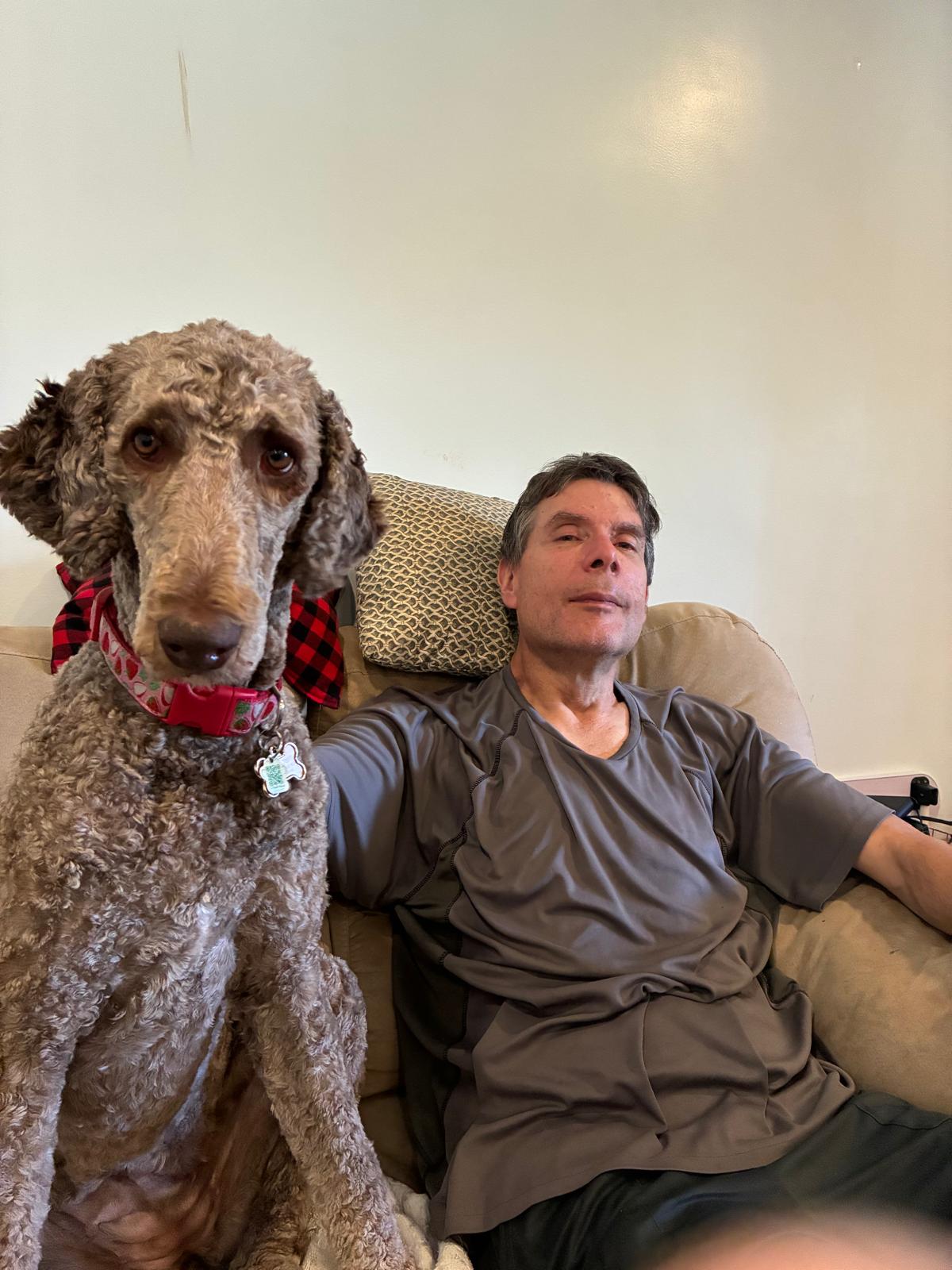
River didn’t know anything about Parkinson’s. River just knew when the room needed to settle — and often did what no pep talk could.
Their advice to other caregivers
>“We learned this on the fly. There’s no manual for it. You just keep showing up.”
— Hayley & Felicia
Caregiver burnout — the part that doesn’t get named enough
>There’s a term for what Hayley and Felicia lived through during this move, and it deserves to be said out loud: caregiver burnout. It’s the exhaustion that comes from managing someone else’s schedule, symptoms, and safety while carrying your own grief about the future. Felicia said it best — “will he be here for this?” — and that question lives in every caregiver who’s ever helped someone through a hard move. You don’t get to stop being a partner, parent, or child just because you’re also a caregiver now. The burnout isn’t a sign you’re failing — it’s a sign you’ve been carrying too much for too long. If that’s you, the stories and videos below are for you.
💛 If you’re a caregiver: your burnout is real, and it matters. You are not invisible in this story. The load you’re carrying is something we talk about openly here — and these two videos speak directly to it:
Minor infection nearly took my wife with Parkinson’s — the caregiving weight that hides in the small stuff.
Caring for a Parkinson’s Patient with Depression — real talk about a load caregivers carry alone too often.
You can find more in the caregiver hub below.
FAQ
>Can stress make Parkinson’s symptoms worse?
>Yes. Stress and strong emotion are well-documented triggers that can worsen or cause symptom fluctuations — both distressing and pleasant emotions can affect motor and non-motor symptoms. It’s why nervous-system regulation matters, not just “staying positive.”
How long does it take to adjust to a new home with Parkinson’s?
>In our experience, three to four weeks before a new space starts to feel safe. The brain needs time to rebuild its mental map and routine.
Does Parkinson’s affect decision-making?
>It can. Cognitive changes — slower thinking, brain fog, difficulty with multiple decisions at once — are common, especially during high-demand situations like a move. This isn’t a character flaw; it’s a symptom.
How can caregivers support someone with Parkinson’s through a big life change?
>Plan high-energy tasks around medication ON windows, reduce decision load, be patient with emotional swings, and — critically — get support for your own wellbeing. Caregiver burnout is real and matters.
Is it okay to hire help when you have Parkinson’s?
>Absolutely. Hiring movers or accepting help isn’t giving up — it’s managing your energy and trusting your body’s limits. It’s one of the smartest decisions I made.
Where you are in this journey matters
>Not everyone reading this is in the same place. That’s okay — that’s exactly why we built the site this way.
- 🌱 Newly diagnosed — start here and see what progression can look like, so it’s less scary when it arrives.
- 🕰️ Long-term — you’ve been walking this road a while. These are the lessons from someone further along.
- 💛 Caregiver — your role is essential and exhausting. This section is for you, not just about you.
Keep going deeper
>This move story connects to the bigger picture of living well with Parkinson’s. If it resonated, these will too:
- Protein & Parkinson’s — how timing your protein can change your day (this matters when your ON time is unreliable, like mine was during the move).
- Levodopa side effects, 9 years in — the honest long-term picture.
- Dehydration & symptom spikes — what I learned when I ignored my water.
Let’s continue to take this journey together. — David
>