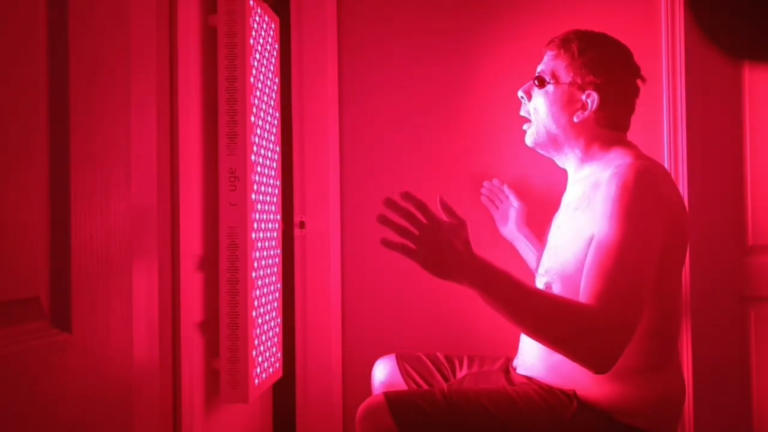





Not a first impression. This is what 3.5 years of daily use actually looks like — documented, tracked, and honest about what held up and what didn’t.
Disclosure: I am listed as a Rouge Ambassador and this page contains affiliate links. If you purchase using my link, I earn a small commission at no extra cost to you. All opinions are my own based on 3.5 years of personal use.
Table of Contents
- Why I’m Writing This Now — An Honest Red Light Therapy Review
- What Red Light Therapy Actually Is — Photobiomodulation Explained
- Lens One: If You’re Newly Diagnosed
- Lens Two: If You’re a Caregiver
- Lens Three: If You’re a Long-Timer
- Beyond Parkinson’s: Red Light Therapy for Joint Pain, Muscle Recovery, and Mitochondrial Energy
- My Rouge Care Canada Timeline — 3.5 Years of Red Light Therapy Benefits
- About Rouge Care Canada & Why Health Canada Certification Matters
- Key Takeaways
- FAQ
- What’s Next — Your Next Steps
- Red Light Therapy for Joint Pain
- Red Light Therapy Muscle Recovery
- Red Light Therapy Recovery Beyond PD
- 🎬 Watch the Full Journey
- 💡 Try It for Yourself
- 📬 Subscribe on YouTube
- 📖 Related Reading

Rouge Care Canada — Red light therapy panels Canadians trust
Why I’m Writing This Now — An Honest Red Light Therapy Review
I didn’t realize how much it was helping until I stopped.
That was week 12 — three months in, and the clearest evidence of what this device was doing for me came from putting it away on purpose and watching what happened. The stiffness crept back. The mornings got harder. Not dramatically — but noticeably enough that I couldn’t pretend it was coincidence.
I started this back in March 2023 as a six-month experiment. I’d read the research on photobiomodulation and Parkinson’s, and I wanted to see if any of it would show up in my day-to-day symptoms. Three and a half years later, it’s not an experiment anymore — it’s just part of how I manage this disease. And that forced pause at 12 weeks is still the most telling data point I’ve got.
Rouge featured my story on their own blog a while back — “Charting a Path to Recovery from Parkinson’s Disease with Red Light Therapy” — and this post picks up where that one left off, three and a half years further into the journey.
This post is built around three different people who might be reading it: someone who just got a diagnosis and is looking for anything that might help, a caregiver trying to figure out how to support a protocol like this, and someone like me — years into this, looking for what actually holds up over time versus what fades after the novelty wears off. If you’re searching for a real red light therapy review from someone who’s actually used it daily for years, this is it — no affiliate fluff, just tracked data.

What Red Light Therapy Actually Is — Photobiomodulation Explained
Here’s the simplest version: shine specific wavelengths of red and near-infrared light on your body, and your cells produce more energy. The mechanism is called photobiomodulation (PBM), and it works primarily through the mitochondria — the parts of your cells responsible for cellular energy production. Unlike some forms of infrared light therapy used for surface heating, red light therapy targets deeper tissue structures.
For Parkinson’s, the theory is that this mitochondrial boost supports the dopamine-producing neurons that the disease progressively damages. The research is ongoing — I’m not claiming settled science — but understanding the mechanisms explains a lot of what I’ve personally experienced.
Here’s what the research interest for red light therapy benefits centers on:
- Red light therapy mitochondria support — Parkinson’s involves mitochondrial dysfunction in dopamine-producing neurons; PBM is theorized to support energy production at the cellular level. This one matters to me beyond just PD symptoms too — more on that below.
- Reduced neuroinflammation — involves a mechanism linked to reactive oxygen species signaling, where controlled light exposure influences cellular repair pathways.
- Motor function and coordination — some studies and patient reports point to improvements in movement quality.

I want to be direct about something here: I am not a doctor, and this is not medical advice. What follows is what I’ve personally tracked and experienced. If you’re considering this, talk to your neurologist first.
Lens One: If You’re Newly Diagnosed
If you’re newly diagnosed, you’re probably in the phase where you’re saying yes to every piece of research that crosses your path — I remember it well. A few honest things I’d tell you before you start:
- Set expectations at zero. My first four weeks showed almost nothing dramatic. The results that made me a believer showed up cumulatively — around the 8-week mark is when I started noticing real change, not day one.
- Consistency matters more than intensity. This isn’t a “use it once when you’re having a bad day” tool. It works as a routine, the same way medication timing does.
- It doesn’t replace anything. This sits alongside your Levodopa, not instead of it. I’ve been on Levodopa for 9 years and red light therapy has never been a substitute for that regimen — it’s additive.
- Talk to your care team first. Bring the research to your neurologist, don’t self-prescribe around them.
Lens Two: If You’re a Caregiver
If you’re the one supporting someone through this — reading research, tracking whether something is actually working, managing logistics — here’s what caregivers should know about a protocol like this:
- It’s genuinely low-burden. Compared to a lot of the tools we’ve tested on this channel, red light therapy is one of the easiest to build into a routine. No apps to manage moment-to-moment, no complicated setup after day one.
- You’ll notice before they do. Hayley has pointed out changes in my rigidity and movement before I consciously registered them myself. If you’re watching closely, you’re a more objective observer than the person going through it — say what you see, even if it feels small.
- Track it plainly, not clinically. You don’t need a spreadsheet. Simple observations — “less stiff in the mornings this week,” “seemed steadier today” — build into a real pattern over months that’s more useful than trying to remember how things felt three weeks ago.
- Respect the OFF rule here too. Don’t try to introduce a new device or evaluate results during an OFF period — same logic as any other conversation or decision.
Lens Three: If You’re a Long-Timer
This is the lens I’m writing from directly. If you’ve been managing Parkinson’s for years and you’re skeptical of another device promising results — I understand that skepticism, I had it too.
What’s different after 3.5 years versus 18 months:
- The benefit is quieter but more foundational. Early on, the change felt noticeable and exciting. Now, it’s less about a dramatic before/after and more about what happens when I stop — which is exactly what I documented in that 12-week update. The absence is more informative than the presence at this stage.
- It’s become a baseline, not an intervention. I don’t think about it as “trying red light therapy” anymore — it’s part of my daily maintenance, alongside things like my protein redistribution timing and the OFF rule.
- Cost-effectiveness holds up. By the 18-month mark I was already confident this earned its place given a one-time cost versus years of consistent use — that calculus only gets better the longer I use it.
- Nothing works forever without adjustment. I’ve since layered in the double panel setup and tested the Rouge Nano for more targeted tremor-adjacent areas — the protocol has evolved, and yours might need to as well.
Beyond Parkinson’s: Red Light Therapy for Joint Pain, Muscle Recovery, and Mitochondrial Energy
One thing I don’t talk about enough — this panel hasn’t just been a Parkinson’s tool for me. The red light therapy benefits extend well beyond motor symptoms. A few other things I’ve noticed, consistently, over 3.5 years:
Red Light Therapy for Joint Pain
My arthritis gets a real boost, every time. I deal with arthritis alongside PD, and I notice a consistent improvement in joint discomfort after sessions — not occasional, but reliable, session after session. If you’re looking into red light therapy for joint pain, this has been one of the most dependable effects I’ve experienced.
Red Light Therapy Muscle Recovery
Muscle recovery has been a genuine surprise. After physical exertion — woodworking projects, a hard day, anything that leaves me sore — red light therapy muscle recovery is noticeably faster with consistent use. I’m confident this has saved me a real physio bill or two over the years. And to be clear — I’m not telling anyone to skip physio. If you need it, go. This has just meant I’ve needed it less often than I otherwise would have.
Red Light Therapy Recovery Beyond PD
Mitochondrial support isn’t just theoretical for me. The mechanism I mentioned above — PBM stimulating mitochondrial energy production — isn’t just something I read about. I feel the effect of it directly in day-to-day energy and resilience, not just in PD-specific motor symptoms. This is where red light therapy recovery becomes a daily tool, not a specialty treatment.
None of this is why I started, but 3.5 years in, these are some of the most valuable red light therapy benefits I get.

My Rouge Care Canada Timeline — 3.5 Years of Red Light Therapy Benefits
Here’s the documented arc, in order, if you want to see the actual progression rather than take my word for it:
| Milestone | Video | What I Found |
|---|---|---|
| Day 1 (Mar 2023) | Red Light Therapy – Rouge Care Canada | Unboxing, setup, first treatment |
| 4 weeks | Update #1 | Early signals, nothing dramatic yet |
| 8 weeks | 8 Weeks of Red Light Therapy | First results that genuinely surprised me |
| 12 weeks | I Didn’t Realize How Much It Was Helping Until I Stopped | The clearest evidence — a forced pause showed me what I’d have missed otherwise |
| ~6 months | Double Red Light Therapy Update #4 | Expanded to a double-panel setup |
| ~9 months | Can the Rouge Nano Reduce Parkinson’s Tremors? | Testing a more targeted, portable unit |
| 18 months | 18 Months With Red Light Therapy – Was It Worth It? | Cost, safety, and versatility verdict |
| 3.5 years (now) | This post | Long-term maintenance, plus arthritis, mitochondrial, and muscle recovery benefits |

About Rouge Care Canada & Why Health Canada Certification Matters
Rouge Care Canada is who I’ve partnered with for this entire journey, and here’s the piece I want to stress: their panels are Health Canada certified. That’s not a small detail — for a medical device you’re putting on your body regularly for years, knowing it’s been vetted against Health Canada’s standards is a big part of why I’ve trusted this device long-term. If you’re looking for the best red light therapy panel you can trust over years, certification was the deciding factor for me.
They also featured my story on their own blog: “Charting a Path to Recovery from Parkinson’s Disease with Red Light Therapy” — which was genuinely validating, since it meant the data I’d been tracking aligned with what they saw in their own customer community.
If you want to look into their products, you can use my custom link here: Rouge Care Canada (affiliate link) — using it supports this channel directly, at no extra cost to you. You can also stack any current Rouge online coupon codes on top of my link — so you’re not choosing between supporting the channel and getting a deal. (I’m proud to be listed as one their Rouge Ambassadors, and the partnership lets me be transparent about that while still giving you the best price.)
Key Takeaways
- Red light therapy works cumulatively, not instantly — give it 8+ weeks before judging results.
- It’s additive to your medication regimen, never a replacement.
- Caregivers often spot changes before the person experiencing them does — speak up.
- The clearest proof of benefit, in my experience, showed up when I stopped using it and felt the absence.
- Beyond PD, it’s consistently helped my arthritis, given a felt boost to mitochondrial energy, and sped up muscle recovery.
- 3.5 years in, this has moved from “experiment” to permanent baseline in my Parkinson’s care routine.
- Health Canada certification was a major factor in my long-term trust in this device.

FAQ
Is red light therapy a proven treatment for Parkinson’s?
No — it’s an area of ongoing research, not an established medical treatment. This post reflects personal experience, not clinical evidence.
How long before I’d notice anything?
In my case, meaningful change showed up around 8 weeks of consistent use, not immediately. The first month was essentially flat.
Does it replace medication?
No. It’s additive, not a substitute — same answer today as it was on day one.
Does it help with anything besides Parkinson’s symptoms?
For me, yes — consistent relief for arthritis, a felt boost in energy I attribute to mitochondrial support, and noticeably faster muscle recovery after exertion. The “Beyond Parkinson’s” section above goes into detail on each.
Is it safe? Is it certified?
My Rouge panels are Health Canada certified, which was a significant factor in my decision to use this device long-term. More detail in the “About Rouge” section above.
What’s different about using it for 3+ years versus a few months?
The benefit becomes foundational rather than dramatic — you notice it most when you stop, not when you start. Lens Three covers this in more depth.
What’s Next — Your Next Steps
🎬 Watch the Full Journey
See the entire arc from Day 1 through 3.5 years — unboxing, weekly updates, the 12-week forced pause, and everything in between.
▶️ Red Light Therapy — Rouge Care Canada (YouTube Playlist)
💡 Try It for Yourself
Rouge Care Canada offers a 60-day return policy on all light panels — so you can try it in your own home and see for yourself. Use my link below (it supports this channel at no extra cost to you, and you can stack any current Rouge coupon codes on top):
🔗 Visit Rouge Care Canada → (affiliate link)
All Rouge Light Panels are returnable within 60 days of purchase — in like-new condition with original packaging. See their full refund policy for details.
📬 Subscribe on YouTube
Subscribe to Life with Parkinson’s on YouTube for video reviews, updates, and honest conversations.
📖 Related Reading
Explore other real-world tool reviews from the Life With Parkinson’s community:
- VILIM Ball Review — One year of daily use for tremor, dystonia, and freezing.
- Moving with Parkinson’s — Cognitive, emotional, and physical strategies for navigating a major life transition.
- Comfort Linen Review — Sleep tools for nighttime stiffness and bed mobility.
- MagnaReady Adaptive Clothing — Magnetic closure clothing that makes dressing easier.