




The quick answer: Protein doesn’t stop levodopa from working — it competes with it. Levodopa is an amino acid, and it rides the same intestinal shuttle buses as the protein in your food. Only 1–5% of your levodopa actually reaches your brain to begin with, so when protein floods those buses, your dose gets left at the curb. The fix isn’t eating less protein. It’s timing it right. After 9 years, here’s exactly how I do it.
Prefer to watch? Here’s the full breakdown.
💡 Key Takeaways
- Protein doesn’t stop levodopa — it competes with it. Both are amino acids fighting for the same intestinal bus seats.
- Only 1–5% of your levodopa reaches your brain to begin with. Protein interference can drop that to near zero.
- The fix is timing, not restriction. Cutting protein causes muscle and weight loss — problems Parkinson’s already brings.
- Carbs by day, main protein by night (~7 PM). Take meds 30–60 minutes before eating.
- Fat is not the enemy. It delays absorption slightly; it doesn’t compete like protein does.
- Dyskinesia may be an instability signal, not “too much med.” Chase stable delivery, not a lower dose.
📍 In this guide
- The Killer Highway — how levodopa actually gets to your brain
- Why protein blocks it (and why fat doesn’t)
- Rethinking dyskinesia: a distress signal, not “too much medication”
- Your path: Just diagnosed
- Your path: For the caregiver
- Your path: For the long-timers
- My real daily protein-timing schedule
- The 5 most common protein mistakes
- What actually works — my system
- FAQ
- Resources & further reading
Hi, it’s David from Life with Parkinson’s. If this is the thing that’s been driving you crazy — meds that work some days and not others, and you can’t find the pattern — you’re in the right place. There’s a good chance the answer is sitting on your dinner plate.
Pick your path:
- Just diagnosed? Read the whole thing — this is the stuff nobody tells you on day one.
- A caregiver? Jump to For the person cooking the meals.
- Been at this for years? Jump to For the long-timers — let’s talk about what changes.
The Killer Highway — the biology in plain English
I grew up in a small town called Squamish, about halfway between North Vancouver and Whistler on the Sea to Sky Highway. When I was young, that road was so treacherous — rockslides, accidents, cliffs on both sides — that people called it the Killer Highway. Would you want to commute on that every day?
Here’s the thing: your levodopa commutes on that highway every single day.
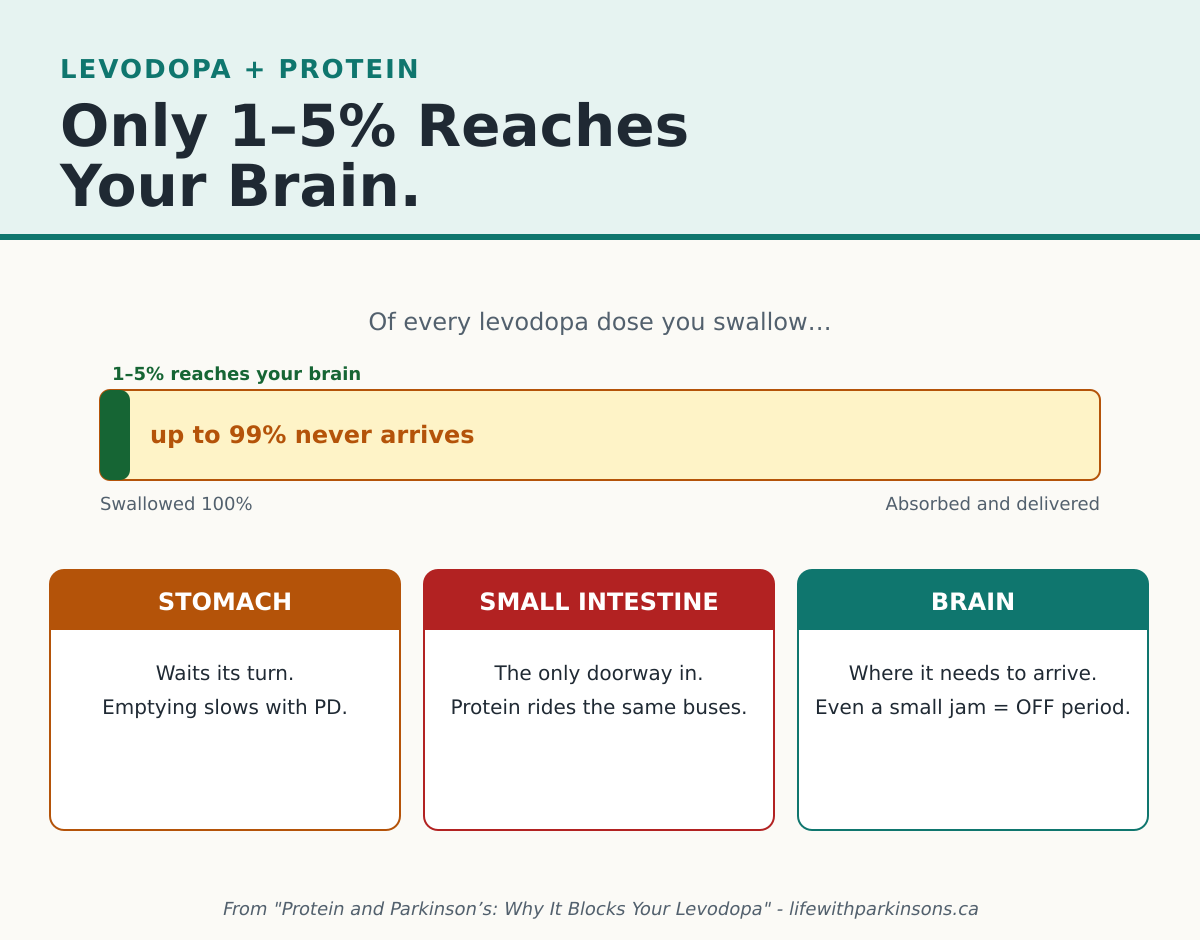
You swallow a pill. It goes down, sits in your stomach, and waits its turn to get into your small intestine — the only place it can start its journey to your brain. And here’s the shocking part most people never hear: only about 1 to 5% of that medication ever reaches your brain. Up to 99% never makes it. You’re already working with a massive bottleneck before anything even goes wrong. One rockslide — one traffic jam — and you drop from 1% to 0%. Suddenly you’re OFF.
Now here’s the kicker: the highway is also a toll road. And the currency is the exact same transport system that protein uses.
Levodopa is just an amino acid — it looks almost identical to the dietary protein you eat every day. In your small intestine, there are specific transporters. Think of them as shuttle buses with limited seating. Eat a high-protein meal and you flood the system with amino acids. They rush the buses and fill every seat. Your medication shows up, tries to board, and the driver says “sorry, not this time.” The dose gets left behind in the gut.
That’s protein interference. It feels like your meds didn’t work — but really, they’re just stuck in traffic.
The full “Killer Highway” and gut-barrier story on video.
Why protein blocks it (and why fat doesn’t)
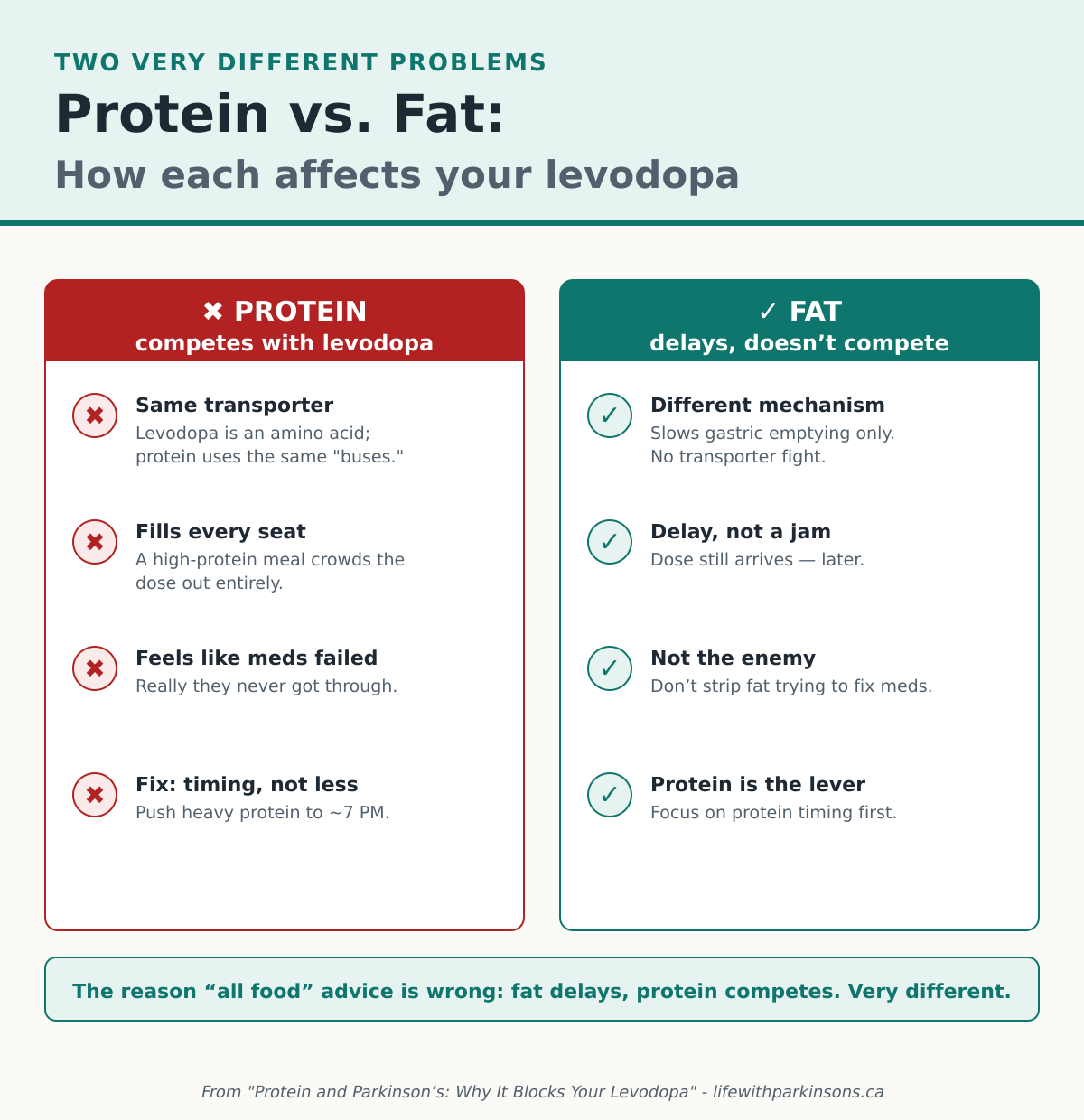
Here’s what surprised even me: fat doesn’t do this. Everyone assumes “food slows my meds” means all food. It doesn’t. Protein competes for the bus seat. Fat just slows how fast your stomach empties — a delay, not a competition. Completely different problem.
Rethinking dyskinesia: it’s a distress signal, not “too much medication”
This is the part I most want you to sit with, because it changed how I manage everything.
We’re told there’s a simple volume knob: too little medication and you freeze up (dystonia), too much and you get the wiggles (dyskinesia). Doctors see dyskinesia and reach to lower the dose.
I challenge that. I don’t think dyskinesia is simply “too much.” In my opinion I think it’s a reaction to a change in speed — an autonomic distress signal.
Go back to that car on the Killer Highway. When the fuel line clogs and the flow sputters, the car lurches and jerks, and the car’s computer starts going haywire because it’s not getting a steady signal. Your autonomic nervous system is that computer — it runs your heart rate, digestion, breathing, balance. When your dopamine delivery is unstable because of protein interference or gut trouble, your brain isn’t getting a steady stream of fuel. Just a sputter.
Here’s the mechanism: the traffic jam eventually clears — and when it does, all that backed-up medication rushes into your bloodstream at once. Spike. Then crash. It’s those spikes and crashes — the instability — that I believe drive the worst motor complications:
- Dystonia is the system cramping up — the brakes locking because the fuel ran out.
- Dyskinesia is the system misfiring — the engine revving uncontrollably because the fuel pressure is erratic.
It’s your body screaming “I don’t have a reliable source of fuel — somebody help me.”
If we treat that by just lowering the dose, we might stop the wiggling — but we often freeze again. We’re not fixing the highway. We’re just taking the car off the road. The goal isn’t less medication. It’s stable delivery.
🌱 For the Newly Diagnosed
If you take one thing from this post: do not start slashing your protein.
I know the instinct. You hear “protein blocks my meds” and jump to “then I’ll stop eating it.” I’ve watched so many people in support groups do exactly that — and six months later they’re losing weight, losing muscle, feeling weaker, and can’t understand why.
Your body still needs protein. Weight loss and muscle loss are already problems in Parkinson’s — don’t accelerate them by accident. The move isn’t less. It’s when. Start with two habits:
- Take your levodopa 30–60 minutes before you eat. Give it a quiet room to work in.
- Make breakfast carbs, not protein. This one change alone fixed my worst-functioning part of the day.
Don’t overthink the rest yet. Just create that gap and watch what happens over a week.
💛 For the Person Cooking the Meals
If you’re the caregiver — the spouse, the son or daughter, the one actually planning and making the food — this is for you, because you’re the one who makes this work.
- Front-load carbs, back-load protein. Breakfast and lunch lean toward oatmeal, toast, fruit, rice, pasta. The main protein — the meat, the fish, the big serving — moves to dinner, around 7 PM in our house. This is protein redistribution, and it’s the single biggest lever you have.
- Watch the “healthy” breakfast trap. Eggs, Greek yogurt, protein smoothies feel responsible. But on top of a morning dose, they’re the enemy. Serving toast instead of eggs feels wrong — but the toast is helping.
- Protect the gap. If meds are at 8:00, keep real protein away until at least 8:30–9:00. That little structure changes the whole quality of someone’s morning.
Hayley figured a lot of this out alongside me, and it took pressure off both of us once we understood: it’s not restriction, it’s rhythm. You’re not putting your person on a sad, limited diet — you’re moving the furniture so the medication has room to work.
🧠 For the Long-Timers
You know levodopa competes with protein — you don’t need the highway lesson. So let’s talk about what actually changes years in.
Here’s what nobody warns you about: the timing that worked in year two stops working in year seven. As your ON/OFF windows narrow, the margin for error shrinks. A protein meal that used to cost you a slightly-late dose can now cost you a full OFF period — or trigger the all-day-dyskinesia-into-nighttime-dystonia cycle that, I’ll be honest, hurts so very much.
What I’ve landed on after 9 years:
- Redistribution isn’t optional anymore — it’s the whole game. Almost all my protein is pushed to that ~7 PM meal, when I don’t need my meds at peak. My daytime doses get a clean runway.
- Plant vs. animal protein isn’t equal. During the day I’ll have vegetables, carbs, and some light plant-based protein — that doesn’t seem to battle the levodopa amino-acid shape nearly as much. Animal protein is the real problem — you can’t stack levodopa against it, it’ll take everything you throw at it. So the heavy animal protein waits for evening.
More on plant vs. animal protein — my full take.
- Watch the leafy greens. Off most people’s radar — I did a whole video on how high-oxalate greens like spinach can work against us. It’s not just protein grams; it’s what specific foods do in a Parkinson’s body.
The leafy greens trap nobody warns you about.
- Unexplained weight loss is a red flag, not a footnote. If the scale is dropping and you don’t know why, protein timing and total intake are worth a hard look with your neurologist. I’ve dealt with this myself — don’t wave it off.
Years in, the lesson is this: it’s not a diet you set once and forget. It’s a living system you keep adjusting as the disease changes. Adjusting is the skill.
My Real Daily Protein-Timing Schedule
People always ask me to just show them a day. So here’s roughly what mine looks like — not a prescription, just a real example of the rhythm. Your times will shift with your own dosing schedule, but the shape of the day is the lesson.
| Time | What I take / eat | Why |
|---|---|---|
| 7:00 AM | First levodopa dose | On a mostly empty stomach — clean runway |
| 7:45 AM | Breakfast: oatmeal, toast, fruit, black coffee | Carbs, not protein — no competition for the morning dose |
| 10:00 AM | Mid-morning dose + light snack (fruit, crackers) | Keep the daytime low-protein |
| 12:30 PM | Lunch: rice or pasta, veggies, light plant protein | Plant protein battles the meds far less than animal protein |
| 3:00 PM | Afternoon dose + carb snack | Steady fuel, no protein spike |
| 6:15 PM | Pre-dinner dose | 30–45 min before the big meal |
| 7:00 PM | Dinner: the main protein — meat, fish, eggs | Heavy protein lands when I don’t need peak ON |
| 10:00 PM | Evening dose | Overnight coverage for turning in bed |
The whole point: my daytime doses run on a clear highway, and the heavy protein “toll” gets paid at night when a slightly-blunted dose costs me the least.
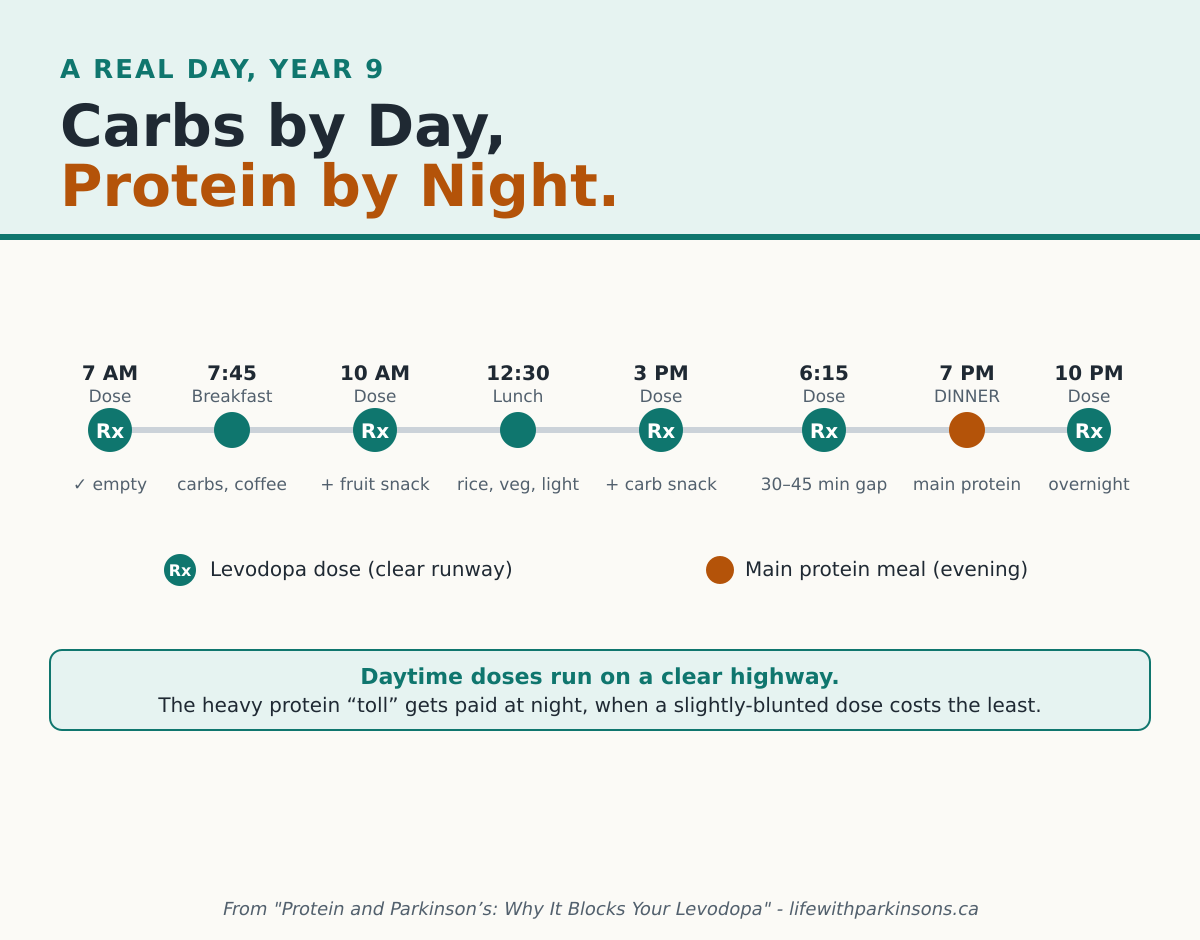
A real day: what I actually eat, and how I keep protein and meds from colliding.
The 5 Most Common Protein Mistakes
After 9 years and a lot of support-group conversations, these are the traps I see over and over:
- The “healthy breakfast” trap. Eggs, Greek yogurt, protein smoothies right on top of the morning dose. It feels responsible. It’s sabotaging your best hours.
- Slashing protein out of fear. You hear “protein blocks my meds” and cut it entirely — then lose weight and muscle you couldn’t afford to lose.
- Treating all protein as equal. Animal protein is the real competitor. Light plant protein during the day is far gentler.
- Ignoring the gap. Taking meds and eating in the same 10 minutes. Give it 30–60 minutes — that gap is the strategy.
- Setting it once and never adjusting. The timing that worked in year two won’t hold in year seven. This is a living system.
What Actually Works (My Real System)
- Meds first, food second — 30–60 minute gap before protein.
- Carbs by day, protein by night — heavy/animal protein pushed to ~7 PM.
- No high-protein breakfast — oatmeal and toast beat eggs.
- Light plant protein is your daytime friend — animal protein is the toll you pay at night.
- Chase stability, not a lower dose — you’re clearing the highway, not taking the car off the road.
None of this is about eating less or eating sadly. It’s about giving your medication the clear runway it needs, so you get more good hours in your day. If the protein timing does help you stabilize weight — or if the weight loss has already happened — there’s one more thing I want to mention that took me by surprise.
Related: why I stopped chasing a “ripped” body with Parkinson’s and started Tai Chi — muscle strategy after 9 years.
When You Lose Weight, You Need New Clothes
Here’s something nobody warns you about in that weight-loss section above: when the pounds come off, none of your clothes fit anymore. It’s true — I laughed about it, but it’s a real thing. New wardrobe, whether you wanted one or not.
And here’s where it gets tricky for us. Buttons. Zippers. Little clasps. With the fine motor problems Parkinson’s brings, getting dressed can turn into a 20-minute wrestling match with a shirt — on a bad morning, an impossible one.

That’s why I use MagnaReady. It looks like a normal button-up shirt, but the buttons are actually hidden magnets — you just press it closed. I wore one to my daughter’s wedding and nobody knew the difference. I just knew I got dressed that day without the fight.
👕 Get 10% off as a viewer of this channel: magnaready.pxf.io/xLEE3O
[FTC Disclosure: This post contains my affiliate link for MagnaReady. If you purchase using my link, I earn a small commission at no extra cost to you. All opinions are my own.]
As always: this is what works for me, not medical advice.
Frequently Asked Questions
Does protein stop levodopa from working?
No — protein doesn’t stop levodopa from working, it competes with it for absorption. Levodopa is an amino acid and uses the same intestinal transporters as the amino acids in dietary protein, so a high-protein meal can crowd out your dose and make it feel weaker or delayed. The fix isn’t eating less protein — it’s timing it so your medication has a clear window to absorb.
What that means for me: For years I thought my meds were “wearing off” when really I’d just eaten a chicken sandwich 20 minutes before a dose. It wasn’t the drug failing. It was a traffic jam in my gut. The fix isn’t less protein — it’s better timing.
How long should I wait to eat protein after taking levodopa?
Take levodopa 30 to 60 minutes before a protein meal, or wait 1 to 2 hours after eating protein before your dose. This gives the medication a clear window to absorb before the amino acids in protein compete for the same intestinal transporters.
What that means for me: I treat my levodopa like it needs a quiet room to work in. Meds first, then a 30–60 minute head start before anything with real protein shows up. It sounds fussy until you feel the difference — and then you never go back.
How much protein can I eat with Parkinson’s?
You don’t need to eat less protein — most people with Parkinson’s still need the full recommended daily amount, around 0.8 grams per kilogram of body weight. You simply need to time it differently, pushing most protein to the evening. Cutting protein can cause muscle loss and weight loss, which are already common problems in Parkinson’s.
What that means for me: This is the one I want to shout from the rooftops. I see so many newly diagnosed people slash their protein out of fear and then wonder why they’re losing weight and getting weaker. It’s not a protein problem. It’s a schedule problem.
What should I eat for breakfast when taking levodopa?
For the best medication absorption, eat a low-protein, carbohydrate-based breakfast such as oatmeal, toast, fruit, or a bagel, and save your main protein for the evening. A high-protein breakfast like eggs, Greek yogurt, or a protein shake taken right around your morning dose is the most common mistake people make.
What that means for me: Breakfast used to be my worst-functioning part of the day and I couldn’t figure out why. Turns out my “healthy” high-protein breakfast was fighting my morning dose every single day. Now mornings are carbs — and my protein waits until around 7 PM.
Does protein cause dyskinesia?
Protein doesn’t directly cause dyskinesia, but poorly-timed protein can trigger it by making your levodopa absorption unstable. When protein blocks a dose, the medication backs up in your gut and then floods your bloodstream all at once when the traffic jam clears. It’s that spike-and-crash instability, not the protein itself, that drives the involuntary movements. The goal is stable medication delivery, not simply a lower dose.
What that means for me: I’ve come to see dyskinesia less as “too much medication” and more as my nervous system panicking over an unreliable fuel supply. Steady, well-timed doses with a clean protein gap give me far smoother days than chasing a lower dose ever did. The goal isn’t less medication. It’s stable delivery.
A Final Thought
I firmly believe every one of you is doing the best you can with the circumstances you’re in. If you’ve been fighting your medication for months without knowing why — this might be the missing piece. It was for me.
Keep the highway clear. Let’s continue to take this journey together.
— David
Resources & Further Reading
- Levodopa Side Effects — A 9-Year Patient’s Guide to Long-Term Use (the companion pillar to this post)
- Protein and Parkinson’s: Three Things You Need to Know (the short version, and more on my shift from animal to plant protein)
- Parkinson’s & Hydration: Staying Fueled for Better Mobility
- Facing Dyskinesia — Chapter 8 of The Parkinson’s Journey
- Oxalates, Thiamine, and My Parkinson’s Symptoms (the leafy-greens rabbit hole)
- My YouTube channel: Life with Parkinson’s