




I can’t believe how quickly the last year has gone.
Time really does fly, especially when you are constantly adapting your life around Parkinson’s.
Hi, it’s David from Life With Parkinson’s.
If you have been following along, you already know I have been testing the VILIM Ball for about a year now. And if you are new here, I want to be clear right from the start: this is not a first impression. This is what it looks like to actually live with something like this every day, over time, through good days and bad days, through symptom changes, through fatigue, through injury, through real life.
And before anything else, I want to say thank you to Vilimed for supplying the VILIM Ball so I could properly test it and share my results. If you are thinking about trying one yourself, you can use the promo code LWP50 to save €50 on your order. And it also supports Life With Parkinson’s, which I really appreciate.
Now let’s talk about what this has actually been like.
Key Takeaways
- The VILIM Ball is not a cure, but in my experience, it became a reliable tool for managing Parkinson’s symptoms, especially during difficult moments when medication alone wasn’t enough.
- What stood out most wasn’t dramatic instant results—it was consistency over time. It kept showing up, session after session, helping me regain small but meaningful control.
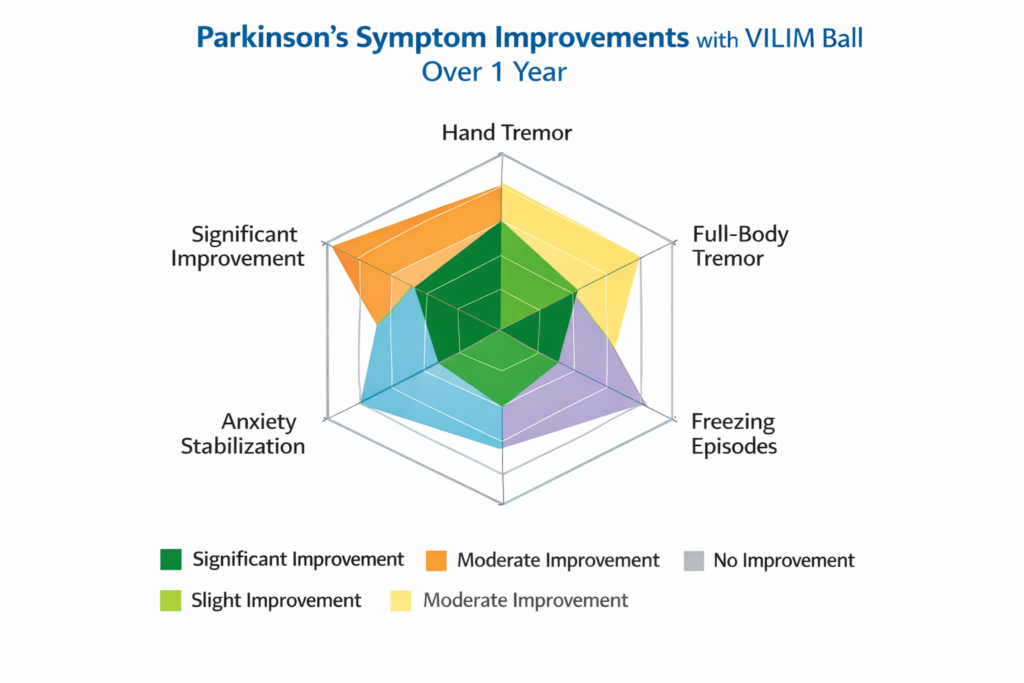
- While designed for tremors, I personally noticed benefits beyond that, including:
- Reduced full-body tremor intensity
- Improved morning mobility (dystonia relief)
- More stable anxiety and freezing episodes
- The effect is temporary, typically lasting a few hours, which means timing matters. I learned to use it strategically before important tasks.
- Compared to medications, the experience felt cleaner:
- No noticeable side effects
- No increasing dependency
- No need for constant adjustment
- The biggest personal win for me:
- Being able to get up and walk within 30 minutes in the morning, instead of waiting hours.
- It works best as part of a broader Parkinson’s management plan, not as a standalone solution.
- After one year of consistent use, it has become something I:
- Carry with me
- Rely on when needed
Why I Even Tried the VILIM Ball
Here’s the thing: this device was created and certified for tremors.
But I am not a tremor-dominant Parkinson’s case.
Most of my symptoms are managed, or sometimes masked, by medication. But underneath that, especially when I am tired, exhausted, or my medication is low for a long period of time, there is a full-body tremor sitting in the background. It is not always visible, but it is there.
And that matters.
Because when you live with Parkinson’s, symptoms do not always show up in the exact way people expect. Sometimes they are obvious. Sometimes they are hidden. Sometimes they are silent until your body is under stress, or you are worn out, or your meds are wearing off.
So about a year ago I thought: let me see what this ball can do for someone like me.
Not just someone with visible hand tremor. Not just a classic case. But someone with non-tremor dominant Parkinson’s, someone dealing with more layered symptoms.
That curiosity is what got me started.
What Surprised Me the Most
The best way I can describe the VILIM Ball is with an analogy.
You know how in a movie there is always the big bad guy, and then there is the good guy, but the good guy is the underdog and he keeps getting knocked down over and over and over again? But every time he gets knocked down, he somehow summons the strength and the will to get back up. Even if it takes him a minute or two, he gets back up. Then he gets knocked down again. And he keeps getting up.
That is kind of how I think about the VILIM Ball.
Because I have thrown everything I can at it.
And it just keeps getting up and keeps performing and keeps relieving symptoms again and again and again.
That is what blew me away.
Not that it was perfect. Not that it fixed everything. But that it kept showing up. It kept doing something useful. It kept giving me results that were consistent enough to matter.
That consistency started to matter more than anything else.
The Bigger Experiment I Was Running
At the same time I was testing the VILIM Ball, I was running a much bigger experiment on myself.
I committed to a fast walking routine.
My goal was simple: see how much I could reduce my medication naturally.
I was following what John D. Pepper talked about — using aerobic exercise to support the brain. The idea was that if I could push my walking enough, maybe I could help my system in a meaningful way.

So I pushed it hard.
I started walking for an hour every single day.
And for a while, it felt like I was making progress.
But I ignored something important.
Rest.
When Things Went Wrong
Eventually, I started getting repetitive strain injuries in my knees.
It hit right at the top of the knee, where the muscle and tendon attach from the quad muscles. If you have ever had that kind of inflammation, you know it is extremely painful and very hard to ignore.
So I had to cut my fast walking in half.
That was enough for my left knee to recover.
But my right knee was still in distress.
I was doing physio exercises every day, and I cut my walking back to almost nothing.
And when I did that, the symptoms came back.
That is the reality of Parkinson’s.
You can manage it, but it is always there in the background.
And when I had to stop walking, I found myself relying more on medication and on the VILIM Ball because the symptoms came back and they were basically saying, pay attention to us.
The Biggest Change for Me: Dystonia
This is probably the most important part of my experience.
Before using the VILIM Ball consistently, my mornings were rough.
I would wake up with my right leg locked.
And all I could do was wait.
Wait an hour.
Wait two hours.
Just waiting for my body to let me walk.
Now my morning routine is different.
I wake up.
I take my pills.
I grab the VILIM Ball.
And I am up and walking in about 30 minutes, sometimes even sooner.
That kind of improvement is not small.
If that was the only benefit I ever got from the device, I would still use it.
Because being able to walk when you wake up in the morning is something I will never take for granted again.
Anxiety, Freezing, and Stability
When I step back and look at the bigger picture, it is not just one symptom.
It is anxiety. It is dystonia. It is freezing of gait.
What I have noticed is that they have all reached a kind of level.
They improved, and then stabilized.
And that stability has held.
For months.
Since my last update, I really have not noticed a worsening of any of those symptoms.
And in Parkinson’s, that kind of plateau is meaningful.
Because the condition does not usually give you a lot of quiet, stable ground to stand on. So when something helps you hold steady, you notice it.
How I Actually Use It
I do not overuse it.
The manual says the maximum is three times a day, and that really seems to be all I need for the amount of relief I am getting.
That is another thing I like about it.
It does not feel like something I have to constantly depend on.
It fits into my routine.
It sits in the background as a tool I can reach for when I need it.
Side Effects and Comparison to Medication
One thing that stands out to me is how clean the experience is compared to medication.
With some treatments I have tried before, especially dopamine agonists, it felt like I needed more and more over time. More medication. More adjustment. More complication.
With the VILIM Ball, I have not experienced that.

There seem to be very few nasty side effects and very few contraindications compared with some of the more complicated treatments I have used in the past.
No major side effects.
No escalating dependency.
It just does what it does.
Where I Am Now
At this point, the VILIM Ball has become a regular part of my Parkinson’s management.
I take it with me wherever I go.
Not because I have to, but because I know it helps.
My symptoms have not disappeared.
But they have stabilized.
And that is something I value more than quick wins or temporary improvements that do not last.
How the VILIM Ball Works in Plain Language
The VILIM Ball’s mechanism is usually explained in terms of sensory gating and neuromodulation. That sounds technical, but the basic idea is not that hard to grasp.
When the ball vibrates in your hand, it sends a steady stream of sensory input through the muscles, tendons, and nerves in your hand and arm. That vibration seems to compete with the tremor signal, making it harder for the tremor loop to keep doing what it is doing.
In simple terms, it gives your nervous system something else to focus on.
Here is how I think about it.
Vibrations on Muscles and Nerves
When the ball vibrates in your hand, it physically stimulates the muscles and tendons. That stimulation sends regular signals back up through the nervous system.
It is almost like a crowd of dancers walking into a quiet room. Suddenly the room is full of activity. The original noise is still there, but it is not the only thing in the room anymore.
That seems to be part of what the VILIM Ball does.
Blocking Tremor Signals
According to Vilimed, those new vibration signals can overshadow the abnormal tremor signals.
The brain cannot listen to everything equally. So when a steadier signal comes in, it can overpower some of the noise that is driving the tremor.
That is the core of sensory gating.
The vibration gates or filters out the unwanted tremor feedback.
The Muscle Response
There is also the muscle response side of it.
The vibration seems to cause a subtle reflex adjustment in the muscles. That can actively dampen the tremor amplitude.
It is a little bit like the body being nudged into a different pattern.
Not forced. Not controlled in a mechanical way. But influenced enough to matter.
Session Details
Each therapy session is designed to be 10 minutes long, and the device automatically shuts off at the end.
The instructions say to use it before daily tasks, up to three 10-minute sessions per day, which adds up to 30 minutes per day per hand.
In practice, most people do one 10-minute session and then go on to do their tasks like eating or writing while still holding it, or use the window afterward when the effect is still active.
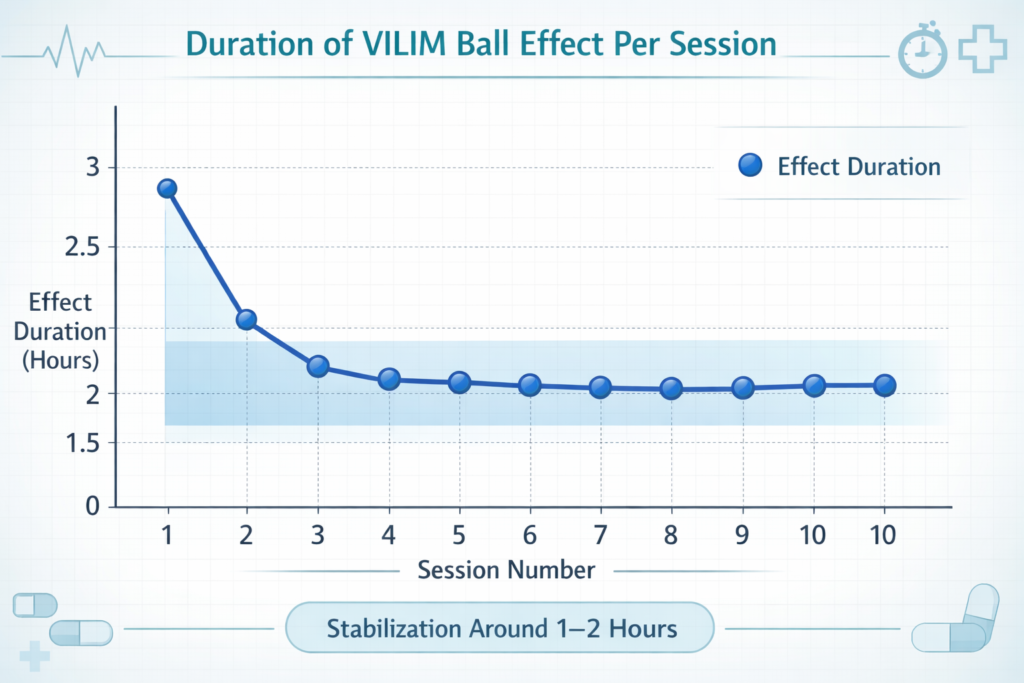
For many people, the effect can last a few hours and then gradually wear off.
That has been true in my experience too.
Temporary Relief, Not a Cure
I think this is important enough to say clearly:
The VILIM Ball is for temporary relief.
It is not a long-term cure.
Multiple sessions over time might support the nervous system in other ways, but that is still something to be cautious about. I would not want to claim more than it can safely claim.
What I can say from my experience is that it seems to provide temporary help when I use it correctly and consistently.
And for me, that is valuable.
Side Effects
One thing I appreciate is that the device seems to come with relatively few side effects.
Some people may notice mild tingling or a bit of fatigue in the hand, especially if they use it longer than recommended.
But compared to medication side effects, it feels much cleaner.
I have not experienced major issues with it.
That matters.
Because with Parkinson’s, every treatment decision is also about what you can tolerate over time.
What Research and Claims Say
Clinical evidence on vibration-based tremor therapy is still developing, but it is encouraging enough to pay attention to.
For Essential Tremor, one published trial using the VILIM Ball itself found that tremor power spectrum dropped significantly after use in a group of 17 patients. There was also a larger follow-up involving 51 patients, including people with Parkinsonian tremor, where 48 out of 51 reported improved tremor control and function, with no serious adverse events reported. Only a small number of Parkinson’s patients reported no effect.
That is important because it suggests the device is not just a gimmick. There is a real physiological basis behind what people are experiencing.
Vilimed’s own summary also reports strong user feedback. In one survey of 35 customers, most of whom had Essential Tremor, a large majority noticed improvement. The Parkinson’s-specific numbers that Vilimed has shared are also encouraging, with several small studies showing many participants felt less tremor after using it.
But I always want to be careful with claims like this.
Because small studies are promising, but they are still small studies.
That means the best way to think about the VILIM Ball is this: it is a tool with encouraging support, not a guaranteed solution.
That is enough for me to take seriously.
And that is enough for me to keep using it.
Recommended Use and Precautions
According to the official instructions and product labeling, the VILIM Ball is designed to be used in a fairly structured way.
You hold it in one hand for about 10 minutes per session. You can do one to three sessions per day, up to around 30 minutes total per day per hand. The device is meant to be used before daily tasks, or during a time when you want tremor relief for an upcoming activity.
That is one of the practical things I have learned: timing matters.
If I know I need steadiness for something important, I do not just randomly use it whenever. I try to time it around the task.
That makes the result more useful.
There are also precautions, and those matter too. The product materials note that people with pacemakers or other implanted electronic devices, epilepsy, acute thrombosis, pregnancy, certain heart conditions, open wounds on the hand, and similar concerns should be cautious and consult a doctor before use.
I always think that is the right approach.
In my own case, I made sure I was comfortable with the precautions before I used it regularly. And I would strongly encourage anyone else to do the same.
You do not want to skip the safety part just because the device looks simple.
Simple does not mean automatic.
Simple still needs responsibility.
My Real-World Results Over Time
This is the part that matters most to me.
Because a device can sound great in theory, and research can look encouraging on paper, but none of that matters quite as much as what happens in real life.
Short-Term: First Use to First Week
The first time I used it, I could tell something was happening pretty quickly.
I noticed some reduction in tremor almost immediately.
My body stayed steadier during the 10-minute session.
It was not perfect, but it was noticeable.
Writing was smoother after the first session. Holding a cup felt less shaky. Even little things like buttoning or brushing my teeth felt easier.
By the third session, I started paying attention to how long the benefit lasted.
The calm feeling in my hand seemed to stay with me for about one to two hours after a session.
That matched the general pattern I had seen in the research and in user reports, so that felt reassuring.
During week one, most days showed a clear benefit.
There were some outliers, of course. One morning, my tremor was much worse than usual because I was stressed, and the ball helped less. But most of the time, it gave me a noticeable reduction.
Tasks That Improved
I paid attention to specific daily tasks because those tell you the most.
Writing:
My handwriting became more legible during and after use. It did not suddenly become perfect, but it definitely improved.
Eating:
This is a big one. Being able to hold a fork or mug more steadily makes meals feel normal again. I even managed to eat cereal without sloshing it everywhere, which may sound small, but it was a big win for me.
Phone Use:
Typing and dialing on my phone became smoother. I needed fewer corrective taps, and that alone makes a huge difference in daily frustration.
Good Days vs Bad Days
Even on days where I felt worse overall, the ball still helped some.
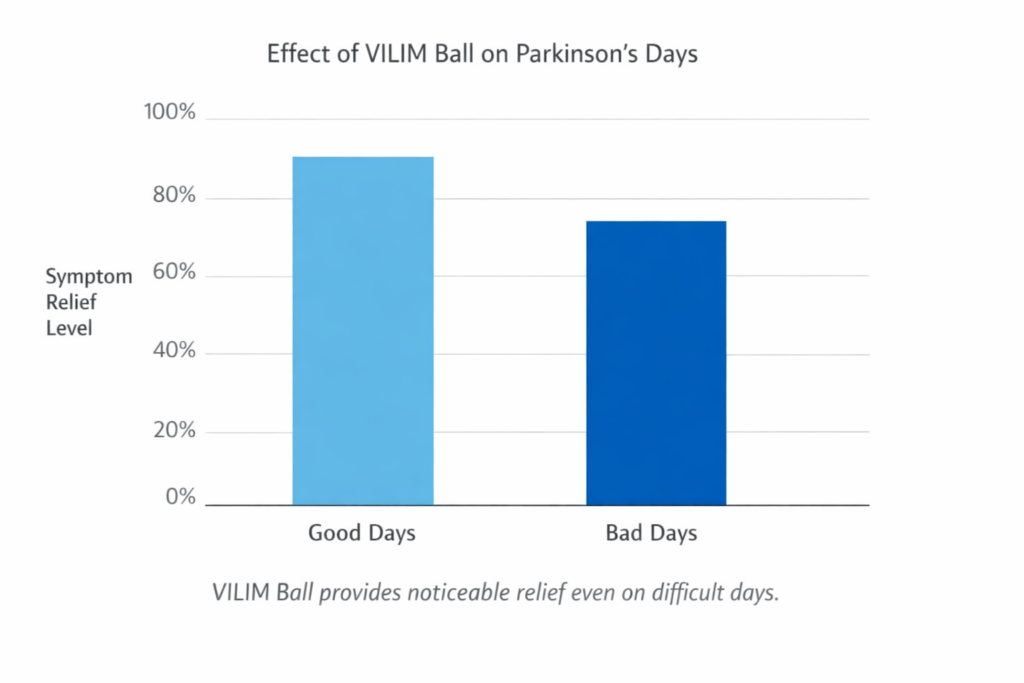
On really bad days, where tremor amplitude felt much stronger, using the ball would not eliminate it, but it could bring it down to a more manageable level.
That matters because Parkinson’s is not about perfection. It is about making the difficult days a little less difficult.
And the VILIM Ball did that for me.
Side Effects in the Early Period
I mostly noticed mild tingling and warmth in the hand after a session.
Nothing painful.
Nothing alarming.
If I overused it, though, I could feel a bit of hand fatigue later, which is why I think the recommended usage range is sensible.
Medium-Term: Two Weeks to One Month and Beyond
By the second week, the device had become familiar.
It was easy to use.
Press. Hold. Wait. Done.
I started using it twice daily because it fit my schedule.
I did not notice any real tolerance building up. If anything, I got better at using it well. I learned how to position my hand more effectively, how to grip it properly, and how to time it around tasks.
I also started comparing how it performed on different kinds of tremor-related tasks.
Holding a small weight:
I noticed a meaningful reduction in tremor in that arm after therapy.
Filling a glass:
I could do it with less spillage after a session.
Action tremor:
It seemed to help most with movement-related tremor rather than pure resting tremor.
That pattern makes sense to me based on how the device works and how tremor itself behaves in Parkinson’s.
The Important Thing About Consistency
Some people report needing more intensity over time with other tools. I did not get that impression with the VILIM Ball.
The same 10-minute session that worked in week one still seemed to work in week four.
That predictability is useful because it lets you plan your day.
And planning matters when you are dealing with Parkinson’s.
When It Helps Less
There were also a few sessions where the effect was less obvious.
Usually these were days when I was under more strain, had poor sleep, was dealing with another issue, or my meds were not in the best place.
That happens.
It did not make anything worse, but it could feel more like a neutral session than a strong one.
That is part of the honesty of using something like this.
No tool works equally well every day.
But that does not make the tool useless.
A Timeline of My Testing
Here is the pattern I noticed over time:
Day 1:
First use. I noticed a clear reduction in tremor.
Day 3:
I started using it more regularly and could already see the benefit window more clearly.
Week 1:
The effects were becoming more predictable, especially around daily tasks.
Week 2:
I was getting better at positioning and timing my use.
Week 4:
It had become a routine part of my daily management.
Week 8 and beyond:
It was no longer “an experiment.” It had become a normal part of my Parkinson’s toolkit.
That transition matters.
Because when a device moves from “interesting thing I am trying” to “part of my routine,” that says something real about its value.
Pros, Cons, and Side Effects
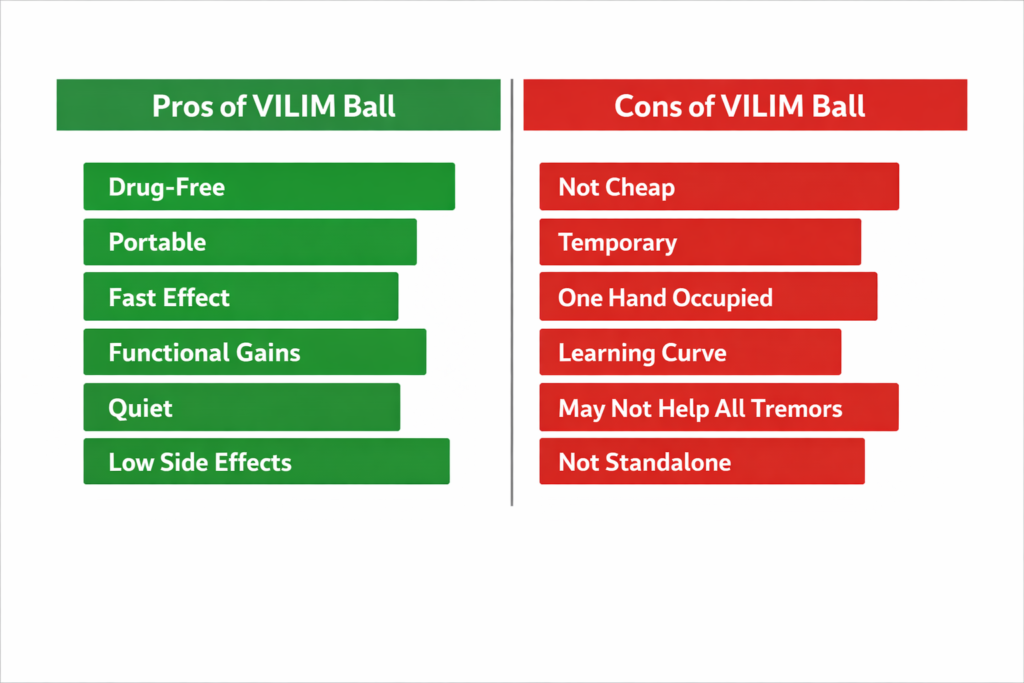
After using the VILIM Ball for a significant period, I have a pretty clear sense of what I like and what I do not.
Pros
It is drug-free and non-invasive.
That is a huge plus for me. There is no surgery, no medication adjustment, and no systemic drug burden.
It is portable.
It is small enough to carry in a bag, which means I can take it with me when I go out.
It works quickly.
The effect can start within minutes, which is useful when you need help before a task.
It can improve real-life function.
Eating, drinking, writing, and using a phone all become easier when it works well.
It is quiet and simple.
I do not have to think too hard about it. That simplicity is valuable.
Battery life has been solid.
It has not felt like a device that constantly needs attention.
It seems to come with a low side-effect burden.
That is not something I take lightly.
Cons
It is not cheap.
That is probably the biggest barrier for many people.
The effect is temporary.
It does not last forever, and you have to work around that.
One hand is occupied while using it.
That is a real practical limitation.
There is a learning curve.
Not a huge one, but enough to matter.
It may not help every kind of tremor equally.
Some days it works better than others.
It is not a replacement for broader Parkinson’s care.
It is a support tool, not the whole plan.
Side Effects I Noticed
For me, the side effects were minimal.
A little tingling.
A little fatigue if I pushed it too far.
No dizziness.
No headaches.
No worsening of symptoms.
That is a good trade in my opinion.
Comparing the VILIM Ball to Other Tremor Tools I’ve Tried
I have also tried or considered other approaches, and that is helpful because it gives the VILIM Ball some context.
Medications
Medication remains a foundation of Parkinson’s management.
It works system-wide, and for many people, that is the biggest advantage.
But it can also come with side effects, dose changes, timing issues, and the need for ongoing adjustment.
The VILIM Ball does not replace medication. But it does give me another layer of support without adding the same kind of medication burden.
Weighted Utensils
Weighted utensils can be useful, especially for meals.
They are inexpensive and simple.
But they do not actually reduce tremor. They just make it easier to work around it.
That is useful, but different.
Exercise and Walking
Exercise is important.
It helped me.
It still helps me.
But I also learned the hard way that overdoing it can lead to injury, which then creates another set of problems.
The VILIM Ball is not exercise, but it can be used alongside it.
Other Tremor Devices
There are other vibration or stabilization devices out there, including glove-style systems and adaptive tools.
Some are interesting. Some are bulky. Some are expensive. Some are still developing.
What I like about the VILIM Ball is that it is straightforward.
It is not trying to be too many things at once.
It is just trying to help tremor.
That focus matters.
When I Reach for the VILIM Ball Instead
I tend to use it when I want targeted support for a limited window of time.
Before a meal.
Before a task.
During a moment when tremor would be especially frustrating.
That is where it fits best for me.
Is the VILIM Ball Worth It? My Honest Verdict
After one year of using it, my answer is yes — with realistic expectations.
It is worth it for me because it gives me a kind of control that I can feel in daily life.
Not every day.
Not forever.
But enough.
Enough to matter.
Enough to make me want to keep using it.
Who Should Strongly Consider It
I think it is most worth considering if:
- You have tremor that affects daily function
- You want a non-drug option
- You need something portable and practical
- You are okay with temporary relief rather than permanent change
Who Might Want Alternatives First
If your tremor is very mild, or if cost is a major concern, or if you are expecting something that completely changes the course of your condition, you may want to think carefully first.
That does not mean it will not help.
It just means expectations should be realistic.
Would I Buy It Again?
Yes.
Absolutely.
Because the functional gains were real.
Being able to drink a cup more steadily. Being able to walk after waking up. Being able to get through the day with fewer symptom spikes.
Those are not small things.
My Final Practical Advice
If you try it:
- Use it consistently
- Pay attention to timing
- Use it before important tasks
- Do not judge it too quickly
- Track what happens on good days and bad days
That is how you will know whether it is actually helping you.
FAQs About the VILIM Ball
How often do I use it each day?
Usually one to three times a day. Most of the time, one or two sessions are enough for me.
Does it help one hand more than the other?
It helps whichever hand is holding it. In my case, I use it in my right hand, so that is where I notice it most clearly.
How long does the effect last?
For me, usually around one to two hours, sometimes longer depending on the day.
Does it replace medication?
No. I use it alongside my medication, not instead of it.
How long until I noticed something?
I noticed something during the first few sessions. It was not something I had to wait months to feel.
Does it help beyond hand tremor?
In my experience, yes. I have noticed it helping with dystonia, anxiety-related tension, and freezing of gait stability too.
Final Thoughts
Living with Parkinson’s means you are always learning how to adapt.
You learn how to pace yourself.
You learn when to rest.
You learn what makes symptoms worse.
You learn what helps, even a little.
And sometimes, a little is a lot.
That is how I feel about the VILIM Ball.
It is not perfect.
It is not a cure.
It does not erase Parkinson’s.
But it keeps showing up.
And in my experience, that has mattered.
The symptoms have found some relief. They have leveled off. They have remained in a better place than they were before. And that matters to me more than I can really put into words.
If the dystonia relief was all I got from it, I would still use it.
If the morning walking improvement was all I got from it, I would still use it.
If the tremor help was all I got from it, I would still use it.
Because being able to move, function, and start the day without waiting forever is something I will never take for granted again.
That is why the VILIM Ball has become part of my Parkinson’s treatment plan.
And that is why I keep it with me wherever I go.
Note for Caregivers
If you’re reading this as a caregiver, I want to take a moment to speak directly to you.
Living with Parkinson’s is one thing. Supporting someone through it every single day is something else entirely.
You’re the one who sees the fluctuations up close.
The good days. The difficult mornings. The moments when things don’t go according to plan.
And you’re also the one helping manage the small details that most people never think about—timing medications, adjusting routines, watching for changes, and stepping in when needed.
From my experience, tools like the VILIM Ball aren’t about replacing care or treatment.
They’re about adding another layer of support.
What I found helpful—and what you might notice too—is that when something provides even a small amount of stability, it can create a ripple effect:
- Mornings become a little easier
- Tasks feel a little more manageable
- Frustration levels can come down
- Confidence can go up
And those small shifts matter more than they seem.
If the person you’re caring for decides to try something like the VILIM Ball, one of the best things you can do is simply help them observe patterns over time:
- When does it seem to help most?
- How long do the effects last?
- Does it make certain daily activities easier?
That kind of awareness can make a big difference in how it’s used.
Also, it’s important to remember that Parkinson’s isn’t static.
What works today might need adjusting tomorrow.
So rather than looking for a perfect solution, I’ve learned it’s more about building a toolkit—and sometimes, this device can become one of those tools.
And finally—don’t forget to take care of yourself too.
Caregiving is a long journey.
And having the energy, patience, and support to keep going is just as important as anything else.
Medical Disclaimer
The information shared in this article is based on personal experience and publicly available research. It is provided for educational and informational purposes only and should not be considered medical advice.
I am not a doctor, and nothing in this content is intended to diagnose, treat, cure, or prevent any medical condition, including Parkinson’s disease or essential tremor.
Always consult with a qualified healthcare professional—such as a neurologist or physician—before:
- Starting or stopping any medication
- Trying new medical devices or therapies
- Making changes to your treatment plan
- Adjusting exercise routines or lifestyle interventions
Individual responses to devices like the VILIM Ball can vary. What works for one person may not work the same way for another.
Additionally, the VILIM Ball may not be suitable for individuals with certain conditions, including but not limited to:
- Implanted electronic devices (e.g., pacemakers)
- Epilepsy or seizure disorders
- Certain cardiovascular conditions
- Pregnancy
- Open wounds or injuries in the hand
Please review the manufacturer’s official instructions and safety guidelines carefully before use.
If you experience any unusual symptoms or discomfort while using any device or treatment, discontinue use and seek medical advice promptly. Your health decisions should always be made in partnership with a licensed medical professional who understands your individual medical history.