

Key Takeaways: MagnaReady Clothing for Parkinson’s
- Buttons become a real challenge with Parkinson’s
Tremor, stiffness, and slow movement make traditional buttons frustrating, time-consuming, and sometimes impossible—especially during “off” periods. - MagnaReady replaces buttons with hidden magnets
The shirts look completely normal on the outside but use magnetic closures inside, allowing them to snap shut easily without fine motor effort. - Designed from real Parkinson’s experience
The product was created to help a husband with Parkinson’s dress independently, which shows in the practical, user-focused design. - Independence and dignity are the biggest benefits
Being able to dress yourself again—even partially—can restore confidence and reduce reliance on caregivers. - Saves time and energy daily
Fewer hand movements mean less fatigue, making mornings smoother and leaving more energy for the rest of the day. - Magnets are stronger than expected in daily use
Real-world testing (sweeping, vacuuming, laundry) showed the shirt stays securely closed during normal activities. - Looks like regular clothing—not medical wear
One of the biggest advantages is that it blends in, helping users feel comfortable in public and social settings. - Useful for both patients and caregivers
It simplifies dressing for people with Parkinson’s and reduces effort for care partners, especially in later stages. - Safety is important for certain users
People with pacemakers or implanted medical devices must consult a doctor before using magnetic clothing. - Higher price but practical value
While more expensive than standard shirts, the benefit comes from ease, comfort, and improved daily living—not just the material. - Works for more than just Parkinson’s
Also helpful for seniors, people recovering from surgery, or anyone with limited mobility or dexterity issues. - Best used as part of a supportive routine
It doesn’t replace all clothing, but it’s a valuable option for difficult days, outings, and important events.
Introduction: When Buttons Become a Battle
If you live with Parkinson’s, or care for someone who does, you already know that the hardest problems are not always the dramatic ones. Sometimes the biggest frustration is something small, ordinary, and completely invisible to everyone else. A button that will not line up. A cuff that twists the wrong way. A shirt that should take one minute to put on, but suddenly turns into a task that drains patience, energy, and confidence before the day has even begun.
That is why clothing matters more than people think.
For many people, getting dressed is one of the first places Parkinson’s starts to push back against independence. Tremor makes hands less steady. Rigidity makes arms harder to lift. Slowness makes even a simple morning routine stretch out far longer than it should. And when medication is not working at its best, those same small tasks can become nearly impossible.
That is exactly the problem MagnaReady is designed to solve.
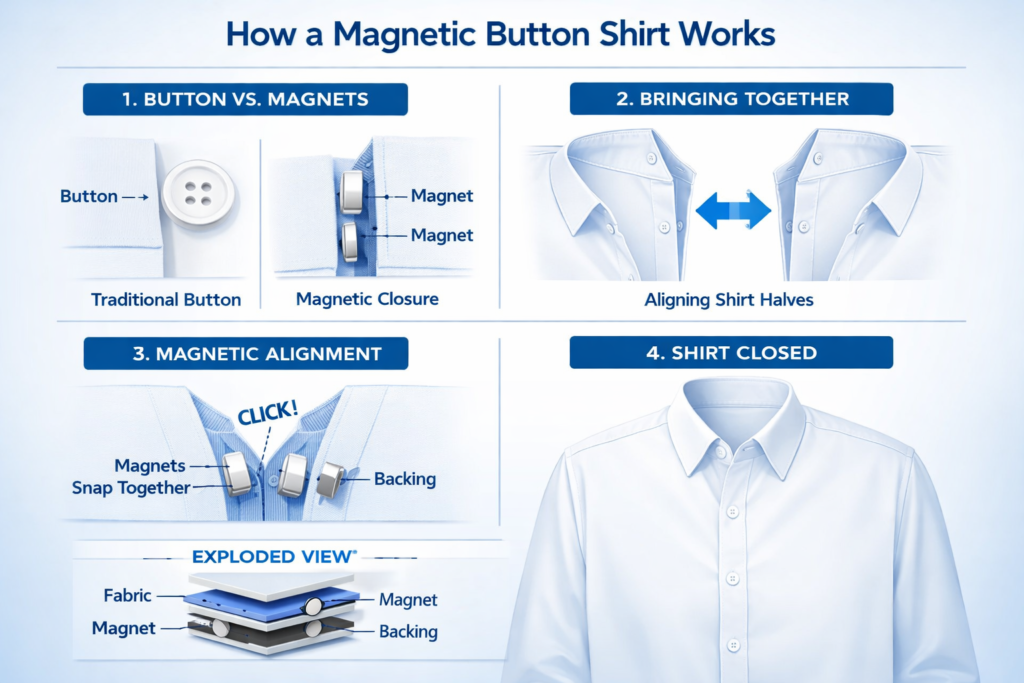
MagnaReady clothing looks like a regular button-down shirt, but inside the hidden button placket are magnets that click together instead of requiring tiny buttonholes and exact finger coordination. From the outside, it still looks like normal clothing. From the inside, it becomes much easier to use.
This guide goes beyond a quick product review. I want to walk you through what MagnaReady is, how it works, what it actually feels like to wear, how the magnets hold up in daily life, who should be careful, and whether I think it is worth buying if you are living with Parkinson’s or helping someone who is.
If you prefer to watch first, here is the full video review that this article is based on:
MagnaReady – Best clothes for Parkinson’s and Disabilities
I also tested the magnetic closures in a separate short video so I could answer the biggest question people usually have right away: do the magnets stay closed when you move around, work, and live your day? That test becomes one of the most important parts of this whole conversation, because it is one thing to see a product online and another thing entirely to see it survive real life.
Before we get into the details, I want to say something clearly. This is not about pretending Parkinson’s does not exist. It does. It affects movement, energy, timing, confidence, and day-to-day routines in ways that are often hard for other people to understand. But if a shirt can give back a little comfort, a little speed, and a little dignity, then that is worth talking about.
What Is MagnaReady and How Does It Work?
MagnaReady is adaptive clothing with hidden magnetic closures built into the placket where buttons normally sit. Instead of forcing you to line up a button and push it through a hole, the shirt uses magnets to pull the sides together and lock them into place. The motion is simpler, cleaner, and much more forgiving for people who do not have steady hands or a lot of finger strength.
What I appreciate most is that the design is discreet. It does not look like a special medical garment. It does not announce itself. It does not make you feel like you are wearing something that was designed only for a hospital or rehabilitation setting. It looks like a regular shirt, which matters more than many people realize.
That visual normality creates dignity.
A lot of adaptive clothing gets the function right but misses the feeling. It works, but it can look obvious. That may be fine in some situations, but it can also make a person feel singled out.
MagnaReady seems to understand that many people with Parkinson’s still want to dress in a way that feels familiar, stylish, and appropriate for daily life. They do not necessarily want the world to see a problem first. They want a shirt that just works.
When you actually use it, the magnets make sense immediately. You bring the two sides together, and they connect fast. No hunting for tiny openings. No repeated failed attempts. No tugging. No feeling of being defeated by your own shirt before breakfast.
In my review video, I pointed out how the magnetic fasteners behave in plain language and how the closures stay hidden. That is important because it reinforces what the shirt is trying to do: it removes difficulty without removing normal appearance.
The company’s story is another reason this product feels different. MagnaReady was created by a wife who wanted to help her husband dress more independently after Parkinson’s made a simple shirt much harder to manage. That kind of origin story matters. It tells you the product was not invented in a vacuum. It came from love, frustration, and a real attempt to solve a real problem.
That usually leads to better design, because the goal is not just “make something new.” The goal is “make something that helps.”
The brand also extends beyond one shirt. MagnaReady offers a line of clothing meant for everyday use and special occasions, which means the concept is not limited to one niche situation. That flexibility matters when you are trying to build a wardrobe that supports real life instead of fighting against it.
If you want to learn more, I recommend checking the official MagnaReady site and reading through the product information and care guidance there. I always suggest that people verify details directly from the brand, especially when safety and fit are involved.
Why Dressing Is So Hard with Parkinson’s
To understand why MagnaReady matters, you have to understand why dressing becomes such a challenge in the first place.
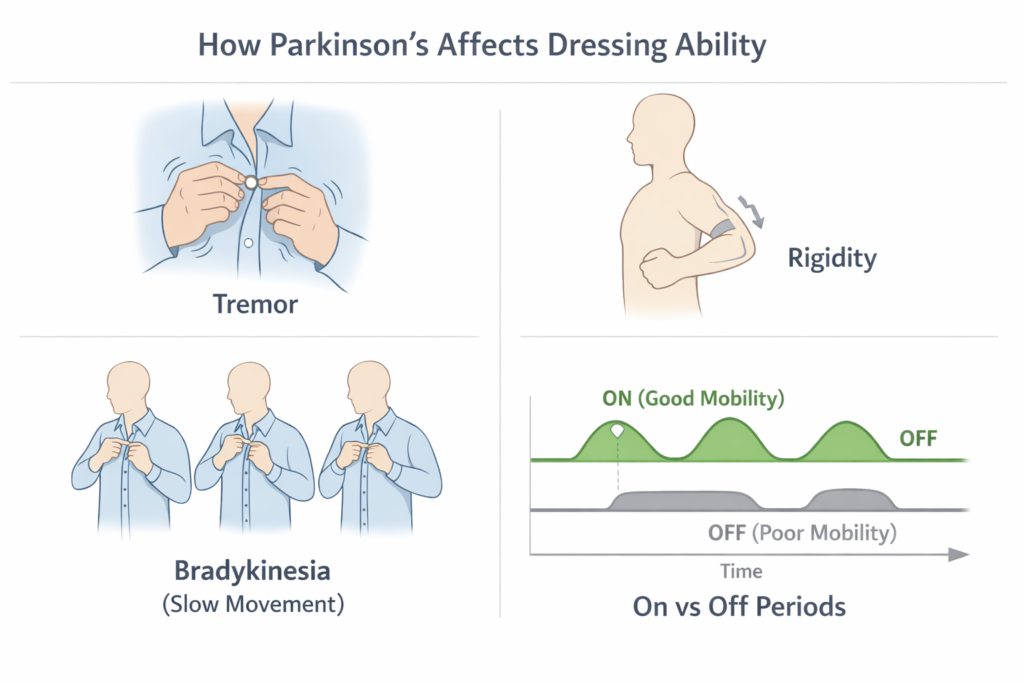
Parkinson’s is not just about shaking hands. It affects movement in ways that can change the entire experience of getting ready in the morning. The person may know exactly what they want to do, but their body does not always cooperate.
Tremor is one obvious factor. A hand that will not stay still makes precise movements more difficult. Buttons require tiny adjustments, and those adjustments are much harder when the fingers are moving without your permission. You can know the task perfectly and still fail at it repeatedly because the body will not cooperate.
Rigidity creates another layer of difficulty. Stiffness in the arms, shoulders, neck, and torso can make reaching across the body awkward or painful. Something as routine as holding a shirt in place can feel like more effort than it should.
Then there is slowness, often called bradykinesia. This symptom can make every stage of dressing take longer. It can make fast movements feel heavy and delayed. It can make even small actions feel like they need too much thought and too much time. And once a person starts feeling rushed or frustrated, the task gets harder still.
But the real challenge is often the unpredictable nature of the disease.
People with Parkinson’s talk a lot about “on” and “off” periods, and those words matter. During an “on” period, medication is working well and the body may cooperate better. During an “off” period, symptoms can come back strongly and suddenly. That means independence can change from one hour to the next. A person may dress themselves fine in the morning and struggle badly later in the day.
That unpredictability is exhausting. It can create anxiety around things that other people never have to think about. What if the shirt does not cooperate? What if I need help? What if I cannot finish getting ready in time? What if I miss an appointment because I got stuck with one stubborn button?
These are not tiny concerns when they happen every week or every day.
That is why an adaptive shirt can be about more than convenience. It can be about preserving identity. When you can still dress yourself, or at least do more of it yourself, you hold onto a piece of independence that Parkinson’s tries to take away.
And that is where the emotional power of MagnaReady really starts to show.
My First Impressions: Unboxing and Quality
My first reaction to the shirt was simple: this feels good.
Not “good for an adaptive product.” Just good.
When I took it out of the package, I noticed the quality right away. The flannel felt substantial and warm. The stitching looked clean. The shirt had weight to it in a way that made it feel durable rather than disposable. It had the kind of construction that makes you think you will still be wearing it long after the novelty has worn off.
That is important because people with Parkinson’s do not need fragile solutions. They need reliable ones.
I also appreciated how normal the shirt looked from the start. The hidden magnets did not make it look bulky. The design did not sacrifice appearance for function. If anything, the shirt reminded me that thoughtful adaptive design can be both practical and attractive at the same time.
One of the nice surprises was how natural the closure felt. The magnets did not feel weak, awkward, or imprecise. They snapped into place with a confidence that made the whole experience feel finished. There was no hovering, no half-closing, no awkward adjustment after the fact. It just worked.
That first impression matters because so many products promise relief and then create more hassle than they solve. A product like this has to prove itself quickly. If it feels cheap, you stop trusting it. If it feels complicated, you stop reaching for it. If it feels embarrassing, you stop wearing it in public.
MagnaReady passed that first test for me.
It also felt like something I could imagine wearing not just once but often. That matters because a good adaptive shirt should not become a special occasion item that sits in the closet. It should become part of your regular rotation, especially on days when energy, coordination, or confidence is lower than usual.
The quality also supports the dignity part of the equation. If you are going to wear something that helps with dressing, it should still feel like a real shirt. It should still feel like something you would choose because it looks and feels good. MagnaReady seems to understand that balance.
Real-World Test: Do the Magnets Stay Closed?
This is the part many people care about most, and for good reason.
A magnetic shirt sounds helpful until you start wondering whether the magnets will pop open at the wrong time. Will the front separate while you are moving? Will it slip while you are bending? Will it fail if you are doing actual daily tasks instead of just standing still?
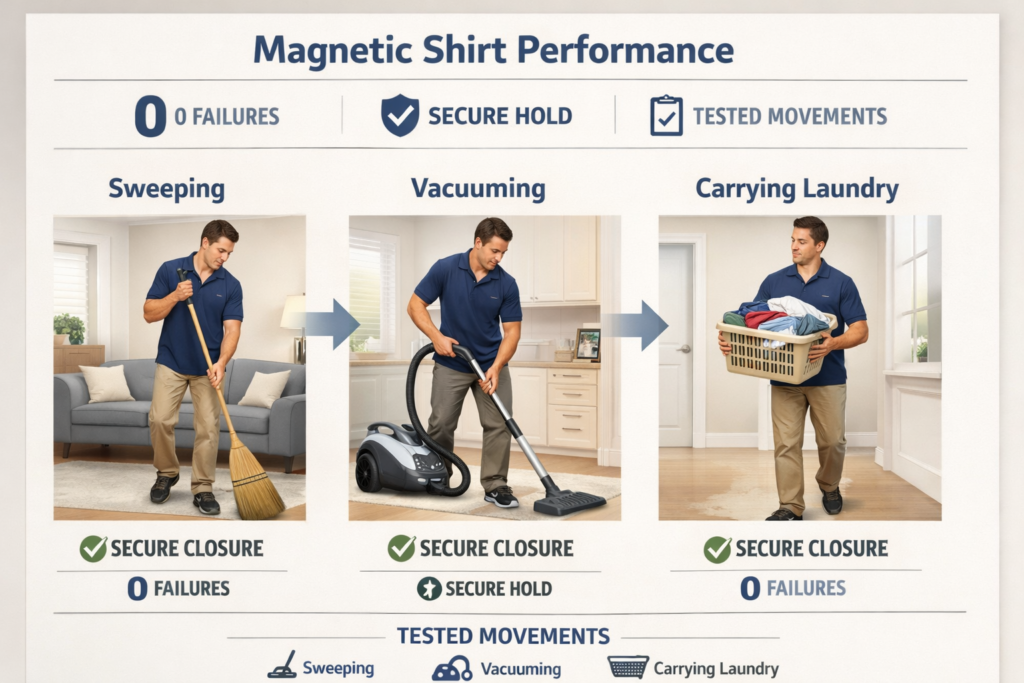
To answer that, I tested the shirt through normal movement and household activity.
I swept the floor. I vacuumed. I carried laundry. I folded clothes. I moved around the way a real person does in a real day.
And the result was encouraging: the shirt stayed closed.
No button came undone. No surprise gaps opened up. No failure happened when I moved through ordinary tasks.
That may sound small, but it is a big deal. It means the product does not just look clever in theory. It performs in practice.
The reason this matters is that trust is everything with adaptive clothing. If a shirt only works when you stand perfectly still, then it is not really solving the problem. People need clothing they can live in. They need something that can handle a little movement, a little bending, a little reaching, and the normal unpredictability of the day.
The magnet test also helps address one of the biggest myths around magnetic clothing: the idea that magnets are too weak to be dependable. In this case, they were dependable during the kinds of activities most people do at home every day.
That matters for people with Parkinson’s, but it also matters for caregivers, because caregivers want solutions that reduce stress rather than create new problems. If the shirt can stay closed during daily use, then it becomes a practical tool instead of a fragile experiment.
I think that is one reason this test is such an important part of the overall story. It gives the product credibility where it counts most: in motion, in routine, and in real life.
Why This Matters in Everyday Life
People who do not live with Parkinson’s may underestimate how much energy gets spent on clothing. A shirt that behaves well throughout the day saves frustration before it even starts. If you do not have to worry about buttons opening, you can focus on the actual day in front of you.
That is where MagnaReady earns its place.
It is not just about getting dressed faster. It is about knowing your clothes are not going to become another thing you have to manage.
Benefits for People with Parkinson’s
Independence & Dignity
This is the heart of the matter.
Parkinson’s can take away independence in ways that feel very personal. Dressing is one of those tasks that people strongly associate with self-sufficiency. When you can do it yourself, it feels normal. When you cannot, it can feel like a reminder of everything the disease has changed.
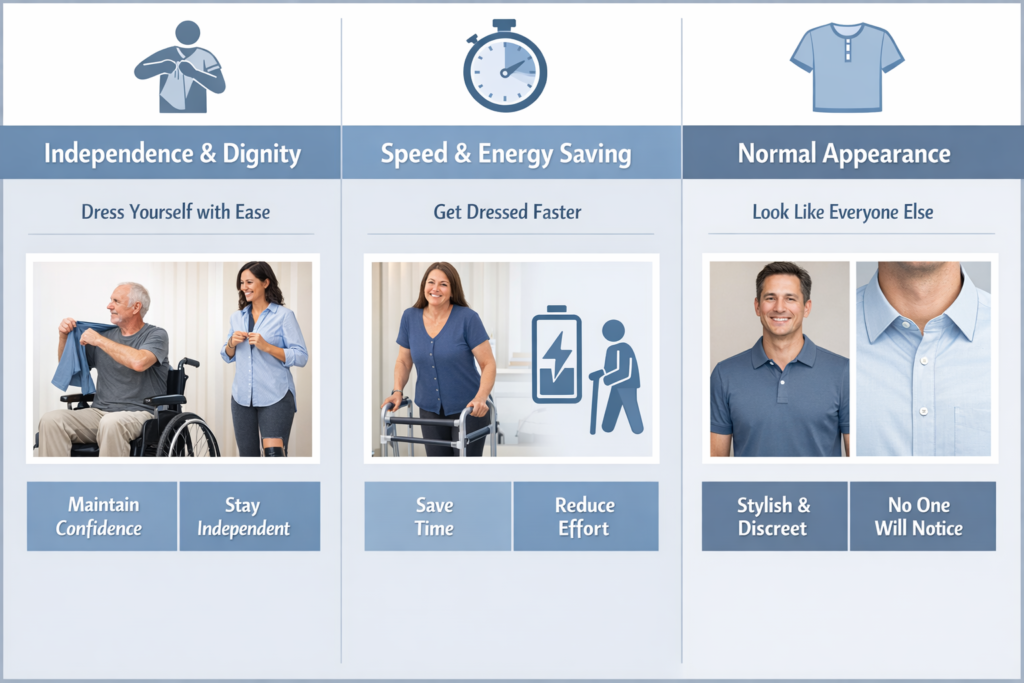
MagnaReady does not magically erase Parkinson’s. Nothing does. But it can reduce the number of moments where you are forced to ask for help with something you used to do alone.
That is not a small thing.
Being able to dress yourself, even just more easily than before, restores a sense of control. It also helps preserve dignity, which is one of the most important parts of living well with a chronic condition. Dignity is not vanity. Dignity is the ability to move through your day without feeling exposed, helpless, or infantilized.
When I talk about this product, I keep coming back to the same idea: sometimes the emotional value of a product is bigger than its physical function.
Speed & Energy Conservation
Anyone living with Parkinson’s knows that energy is not unlimited. Some mornings it is already in short supply. That means the fewer extra movements you need, the better.
A traditional button-down shirt requires repeated fine motor actions. You have to align, push, adjust, and often try again. With magnetic closures, that process becomes much simpler.
Fewer movements mean less fatigue. Less fatigue means more energy left for the rest of the day. And more energy can make a real difference, especially if the person is trying to manage appointments, work, family responsibilities, or simple daily routines.
That is one of the reasons adaptive clothing is worth taking seriously. It is not about making life fancy. It is about reducing unnecessary effort.
Looks Like Regular Clothing
This is another major win.
A lot of adaptive products work well but look obviously adaptive. That may be fine in some situations, but it can also make a person feel singled out. MagnaReady avoids that problem by keeping the look familiar and polished.
The shirt still looks like a regular button-down shirt. That means you can wear it to appointments, family gatherings, casual outings, or special events without feeling like your clothing is announcing your condition before you do.
That subtlety is powerful.
It lets the clothing help without drawing attention.
And for many people, that is exactly what they want.
Safety & Who Should Be Careful
This section is very important, and I want to be direct about it.
Magnetic closures are not for everyone.
If you have a pacemaker, a defibrillator, implanted medical device, catheter system, or anything else that could potentially be affected by magnetic interference, you should speak with your doctor or healthcare professional before using MagnaReady clothing. Do not guess. Do not assume. Get proper medical advice first.
That caution is not a sign that the product is unsafe for everyone. It is just responsible guidance. Any product using magnets should come with a clear awareness of who should and should not use it.
There are also practical safety considerations outside of medical devices. Keep magnets away from credit cards, hotel key cards, and anything else that could be affected by magnetic fields. This is the same basic precaution many people already follow with other magnet-based accessories.
Why is it so important to mention this in a review?
Because trust depends on honesty.
If I were only praising the product and ignoring the cautions, that would not help anyone. A good review should tell you both what works and what to watch out for. That way, the reader can make a smart decision instead of an emotional one.
Parkinson’s is already complicated enough. The goal is to simplify life, not create avoidable problems.
When I Wear MagnaReady: Everyday Life & Special Occasions
One of the most useful things about MagnaReady is that it does not feel restricted to one situation.
Everyday Life
This is the easiest use case to understand. Around the house, a magnetic shirt is just easier. If you are having a rough day, if your hands are not cooperating, or if you simply want to reduce the effort required to get dressed, it can help immediately.
You can put it on without turning the morning routine into a struggle. That alone is valuable.
It also works well for appointments. Medical visits are already full of enough stress. The last thing you need is a clothing battle before you even walk out the door. When a shirt makes the process smoother, it sets a better tone for the day.
Special Occasions
This is where the emotional side of MagnaReady really comes through.
In my case, one of the biggest reasons I appreciate MagnaReady so much is that I can picture myself using it during important life moments. I actually wore a MagnaReady outfit to my daughter’s wedding, and that experience stayed with me. It wasn’t just about looking presentable—it was about being able to get ready on my own, without frustration, and without needing help at the worst possible moment.
What stood out to me even more was how the pants are designed. Just like the shirts, they are made with ease in mind. The closures are simple and intuitive, allowing you to get dressed without struggling with fine motor movements. There’s no fighting with buttons, no awkward balancing, no stress. Everything is designed to work with you, not against you.
That kind of thoughtful design makes a real difference, especially during events where emotions are already high. A wedding, a family gathering, or any meaningful occasion should be about the people, the memories, and the significance of the day—not about whether you can manage your clothing.
For me, wearing MagnaReady meant I could stay focused on what truly mattered. I could be present, enjoy the moment, and take part fully without that background stress.
And that’s why this isn’t just about clothing. It’s about dignity, independence, and being able to show up for life’s most important moments with confidence.
That is something worth celebrating.
Pros, Cons, and Things I’d Change
Before making a decision, it helps to lay out the strengths and the limitations clearly.
The biggest strengths are easy to see. The shirt is fast to put on. It feels well made. It looks like normal clothing. The magnetic closures work reliably during real movement. It supports dignity and independence. It is especially helpful for anyone dealing with tremor, stiffness, or limited fine motor control.
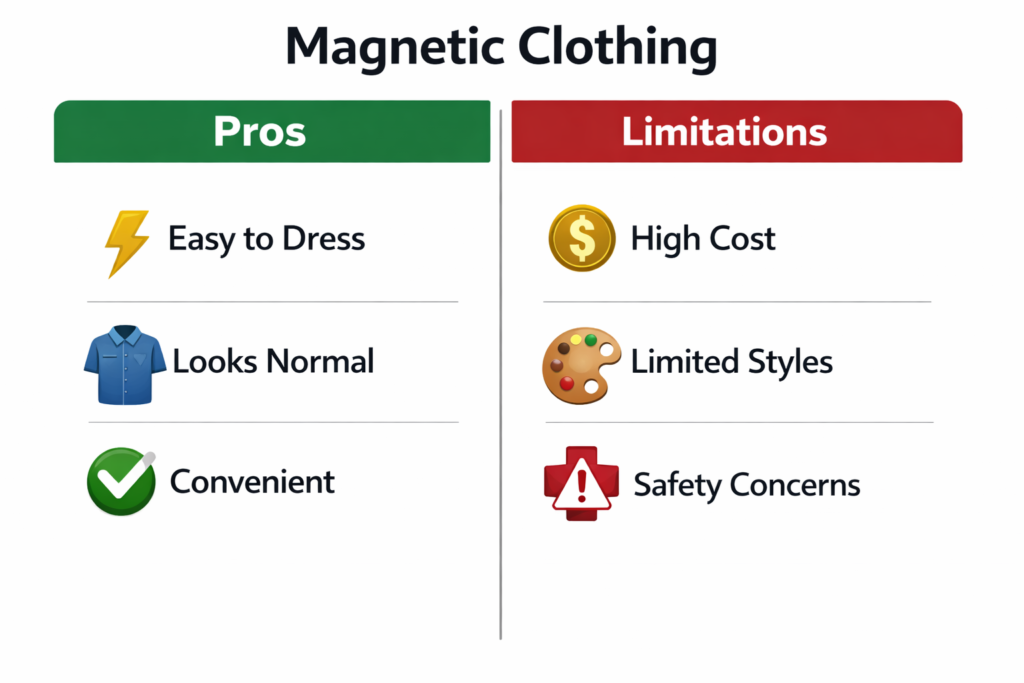
There are also some tradeoffs.
The first is price. Shirts like this usually cost more than a standard shirt from a mainstream clothing store. That is understandable, because the design is specialized, but it still matters when you are deciding whether to buy.
The second is variety. Compared with big mainstream brands, the style selection can feel more limited. That may not bother everyone, but it is worth noting if you are trying to build a larger wardrobe.
The third is safety. As already mentioned, people with certain implants or devices need to be careful.
If I were to suggest a future improvement, it would be even more variety in styles and colors. The functionality is already strong. More options would make the line even more useful for different personalities, seasons, and occasions.
Quick Verdict on the Tradeoffs
Overall, the tradeoffs make sense. You are paying for function, thoughtfulness, and dignity. For the right person, that is a worthwhile exchange.
Is MagnaReady Worth It for Parkinson’s? My Verdict
For me, the answer is yes—with the right expectations.
If you are someone who struggles with buttons, has stiff hands, experiences tremor, or loses independence during off periods, MagnaReady can make a real difference. It is practical, well designed, and respectful of the fact that people with Parkinson’s still want to look and feel like themselves.
If you are a caregiver, it may also reduce stress. Dressing becomes faster, gentler, and less frustrating for everyone involved. That matters in daily care because small wins add up.
I also like that MagnaReady does not try to sell itself as a miracle. It is not curing Parkinson’s. It is not pretending the disease is easy. It is simply solving one specific problem in a thoughtful way.
That is often the mark of a genuinely useful product.
Would I buy it again?
Yes, I would.
Not because it replaces every shirt in the closet, but because it earns its place by making life a little easier on the days when that matters most.
If you want to see my full experience again, watch the complete review here:
MagnaReady – Best clothes for Parkinson’s and Disabilities
And if you find this kind of real-life Parkinson’s content helpful, please consider subscribing to Life With Parkinson’s. I share tools, experiences, and honest reviews that are meant to help people living with Parkinson’s and the caregivers supporting them.
FAQ Section
Do the magnets ever come undone during the day?
In my experience, they did not. I tested the shirt during normal household activity, and it stayed closed.
Are MagnaReady shirts heavy because of the magnets?
No. The shirt still feels like a regular shirt. The magnets do not make it feel bulky or uncomfortable.
Can care partners use these to dress someone in late-stage Parkinson’s?
Yes, they can be very helpful for caregivers. Anything that reduces steps and frustration can make dressing easier in more advanced stages.
How do you wash MagnaReady clothing?
Follow the brand’s care instructions carefully. I always recommend checking the official guidance on their site so the shirt keeps its fit, appearance, and magnetic function.
Is this only for Parkinson’s?
No. People with mobility issues, tremor, stiffness, recovery-related dressing challenges, or other movement difficulties may also find it useful.
Is it worth the higher price?
For many people, yes, because the value comes from independence, comfort, and ease of use rather than just the fabric itself.
At the end of the day, MagnaReady is about more than a shirt. It is about making dressing less of a battle and life a little more manageable. For someone living with Parkinson’s, that can mean a great deal.
And sometimes, a small improvement in the morning routine creates a better whole day.
Medical Disclaimer
The information provided in this article is for educational and informational purposes only and is based on personal experience living with Parkinson’s, along with general observations of adaptive clothing such as MagnaReady. It is not intended to replace professional medical advice, diagnosis, or treatment.
Parkinson’s disease is a complex neurological condition that affects individuals differently. What works well for one person may not be suitable for another. Always consult with a qualified healthcare professional, such as a neurologist, primary care physician, occupational therapist, or movement disorder specialist, before making changes to your daily routine, assistive tools, or lifestyle.
A Note for Caregivers
If you are a caregiver, whether a spouse, family member, or professional, your role is incredibly important—and often more demanding than people realize.
Dressing is one of the most frequent daily challenges for someone living with Parkinson’s. It can be physically difficult, emotionally frustrating, and time-sensitive, especially during “off” periods when mobility is reduced. As a caregiver, you may find yourself stepping in more often than either of you would like.
That is where tools like MagnaReady can make a meaningful difference—not just for the person you are caring for, but for you as well.
Supporting Independence Without Taking It Away
One of the hardest balances in caregiving is knowing when to help and when to step back.
Adaptive clothing can give your loved one the ability to do more on their own, even if only partially. That small return of independence can improve confidence, mood, and overall well-being. When possible, allow extra time and space for them to try dressing independently with tools that support success.
Reducing Stress During Daily Routines
Morning routines can quickly become stressful if dressing turns into a struggle. Magnetic closures reduce the number of steps required, which can:
- Shorten dressing time
- Lower frustration for both of you
- Create a calmer start to the day
Less stress in small moments often leads to better overall days.
Practical Assistance When Needed
In more advanced stages of Parkinson’s, or during difficult “off” periods, caregivers may still need to assist with dressing. MagnaReady clothing can make this process smoother by:
- Eliminating the need to align and fasten small buttons
- Reducing physical strain on both the caregiver and the person being dressed
- Allowing quicker adjustments when needed (e.g., bathroom access)
Emotional Awareness Matters
Dressing is not just a physical task—it is tied to identity and dignity.
Be mindful that needing help with clothing can feel discouraging or even embarrassing for some individuals. Simple encouragement, patience, and respect go a long way. Adaptive clothing helps, but emotional support is just as important.
Safety First
Always remain aware of:
- Balance and fall risks during dressing
- Fatigue or stiffness that may worsen throughout the day
- Any medical restrictions related to magnetic products
If your loved one uses medical devices, confirm with a healthcare professional that magnetic clothing is safe.
Final Thought for Caregivers
You are not just helping someone get dressed—you are helping them maintain a sense of self in a situation that can feel unpredictable and overwhelming.
Tools like MagnaReady do not replace caregiving, but they can make your role easier, more efficient, and less stressful, while giving your loved one something just as valuable: a little more control over their own life.